Skip to content
France

40 francs gold coin

France · 1803-1839 · Gold

Written by the Maison Or & Bijoux Cagnes-sur-Mer team · updated

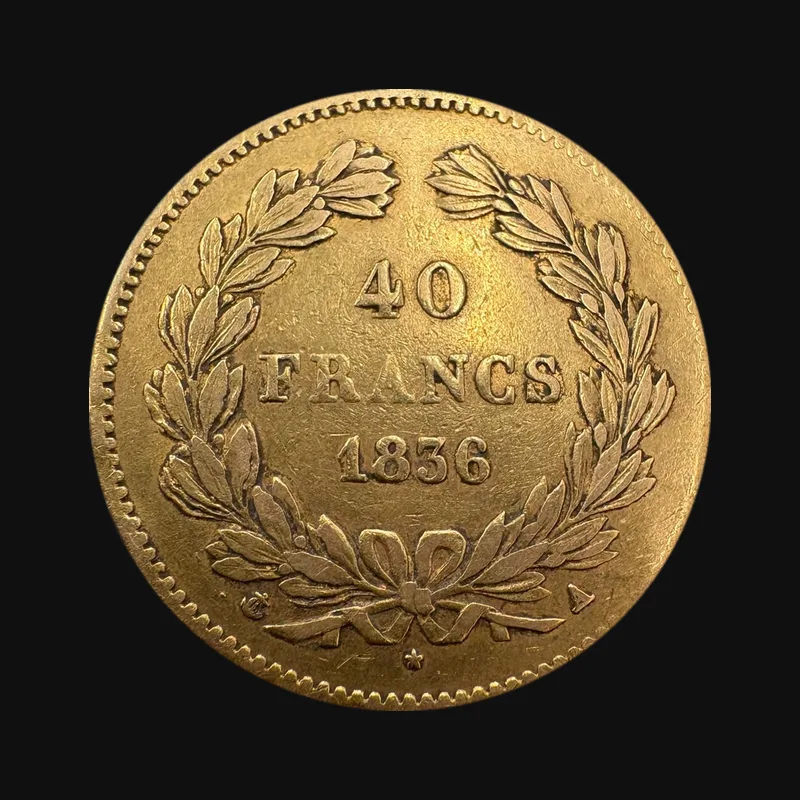
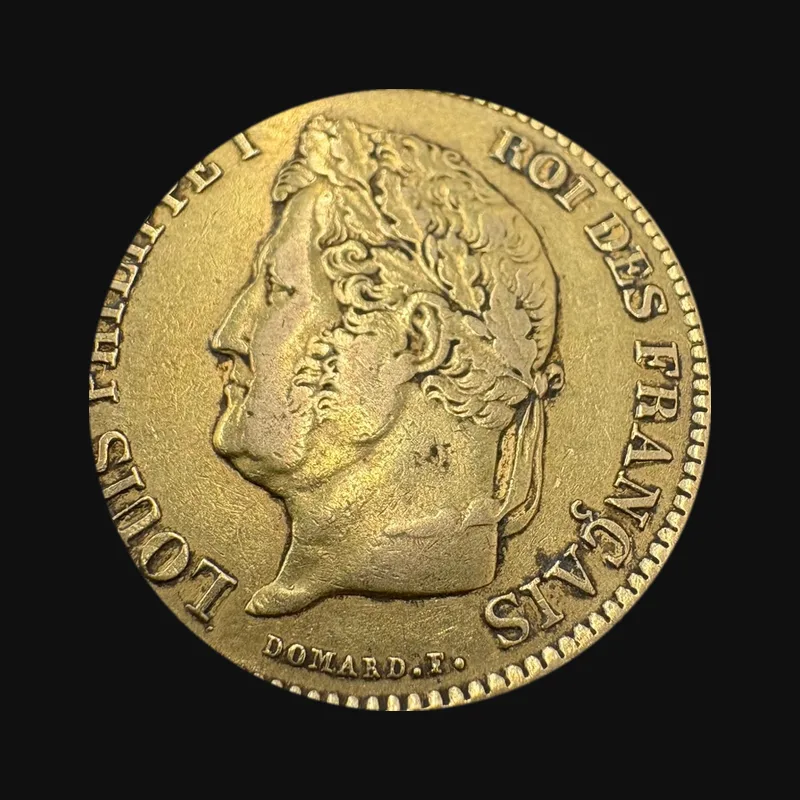
40 francs gold of Louis-Philippe I, laureate head signed Domard, obverse40 francs gold dated 1836, reverse with the value in a wreath
Photos: Maison Or & Bijoux.
Specifications
CountryFrance
MetalGold, 900‰ fine
Weight12.90 g
Fine gold11.613 g
Diameter26 mm
Years struckYear XI (1803) to 1839
Types11 in the Le Franc catalogue: Consulate and Empire 6, Louis XVIII 1, Charles X 3, Louis-Philippe 1
MintsMostly Paris (A); also Rouen (B), La Rochelle (H), Limoges (I), Bordeaux (K), Bayonne (L), Toulouse (M), Marseille (MA), Perpignan (Q), Turin (U), Lille (W), Genoa (CL)
Mintage by typeFirst Consul 479,521; Empire 1809-1813: 2,101,580; Louis XVIII 539,486; Charles X 478,824; Louis-Philippe 775,252 (BDOR)
EngraverTiolier, Droz, Michaut or Domard, depending on the reign
Edge“DIEU PROTEGE LA FRANCE” (Empire, Louis-Philippe), “DOMINE SALVUM FAC REGEM” (Restoration)
ReferencesLe Franc F.536 to F.546; Gadoury 1092 (Louis XVIII), 1105 (Charles X, 2nd type); KM 652, 696, 713, 721, 747

At 26 mm across, the 40 francs gold coin is far larger than the 20 francs napoléons it often shares a family jewellery box with. It weighs 12.90 g, holding 11.613 g of pure gold, and it was struck for only thirty-six years, from Year XI of the Republican calendar (1803) to 1839. Five rulers placed their profile on it: Bonaparte as First Consul, Napoleon I, Louis XVIII, Charles X and Louis-Philippe. Our shop has photographed a Louis-Philippe example dated 1836.

Identification

40 francs gold coin: how to recognise it

40 francs gold of Louis-Philippe I, laureate head signed Domard, obverse

Obverse

The profile and titles change with each regime. Bonaparte, bare-headed, for Years XI and 12 (“BONAPARTE PREMIER CONSUL”); Napoleon (“NAPOLEON EMPEREUR”) from Year 13 to 1813, bare-headed until 1807 and wearing a laurel wreath from then on; then “LOUIS XVIII ROI DE FRANCE”, “CHARLES X ROI DE FRANCE” and finally “LOUIS PHILIPPE I ROI DES FRANÇAIS”, with a laureate head.

40 francs gold dated 1836, reverse with the value in a wreath

Reverse

Three designs. Under the Consulate and the Empire, the value “40 FRANCS” and the date sit inside a wreath, with the legend “REPUBLIQUE FRANÇAISE” until 1808 and “EMPIRE FRANÇAIS” afterwards. Under the two Restoration kings, a crowned shield with fleurs-de-lis between two branches, with “40 F.”. Under Louis-Philippe, the value returns inside a wreath. The mint mark is found below the date or below the shield.

Edge
Raised lettering. Napoleon and Louis-Philippe: “DIEU PROTEGE LA FRANCE” (God protect France). Louis XVIII and Charles X: the Latin “DOMINE SALVUM FAC REGEM” (Lord, save the King). The 1830 Charles X coin comes with three edges: incuse lettering, raised lettering, or plain.
Engraver
Four engravers in turn: Pierre-Joseph Tiolier for the First Consul, Jean-Pierre Droz for the Emperor, Auguste-François Michaut for the Restoration kings, and Joseph-François Domard for Louis-Philippe, whose signature appears below the bust.
Dates and mintages

40 francs gold coin: key dates

The table runs in date order, from the Consulate to the July Monarchy. Most coins found today come from Paris in 1811 and 1812, two years with more than half a million pieces each. The tiny mintages belong to Louis XVIII and Charles X (1822, 1823, 1826, 1827) and to the very last year, 1839. The Louis-Philippe type is listed year by year, 1836 included.

40 francs gold coin: dates and mintages
YearMintMintageRemarks
Year XIA226,115First Consul; reverse with or without olive
Year 12A253,406Last First Consul year
Year 13 - Year 14A, U, W372,696 (type total)Emperor, bare head; split by mint unknown
1806 - 1807A, I, M, U, W291,584 (type total)Bare head, transitional type in 1807
1807U619Turin, transitional type (613 per Coinvarieties)
1807 - 1808A, H, M, U, W71,866 (type total)Laureate head, Republic legend
1809A12,779First Empire reverse
1809M1,402Toulouse
1810K886Bordeaux; rarest Empire reverse date
1810W57,478Lille
1811A1,261,764Largest mintage of the series
1811K6,333Bordeaux
1812A692,625Common
1813A44,895Napoleon's last 40 francs
1813CL3,070Genoa
1816A41,073First Louis XVIII year
1816B767Rouen
1818W352,878Lille, largest of the reign
1822A373Tiny mintage
1823A161Rarest Louis XVIII date (155 per Le Franc)
1824A15,200Louis XVIII: three dots, one dot or none
1824A50,090Charles X, first portrait
1826A62Charles X, second portrait; extremely rare
1827A106Extremely rare
1830A353,112Ordinary Charles X year; “3” level or low
1830A1,324Raised edge variety (F.545)
1830MA1,026Only 40 francs ever struck in Marseille
1831A62,563Louis-Philippe, first year
1832A22,493Paris
1832B3,947Rouen
1833A221,449Large mintage
1834A331,495Largest of the reign
1834L12,451Bayonne
1835A7,450Low mintage
1836A52,738Date of the coin photographed in our shop
1837A28,224Paris
1838A31,027Paris
1839A17 to 23Final year: 17 per Le Franc, 23 per BDOR; a major rarity

Year-by-year figures from the BDOR tables; date and mint combinations checked against the Le Franc catalogue (F.536 to F.546). Coinvarieties sometimes differs: 1,260,360 for 1811 A, 613 for 1807 U, 380,612 for 1830 A, 301,979 for 1834 A; Le Franc gives 155 for 1823 A. For 1804 to 1808, only each type's total is reliably published.

Measure, weigh, read the reverse

Three checks settle most cases. With calipers, a 40 francs coin measures 26 mm. On a scale accurate to a hundredth of a gram, it reads 12.90 g, a little less if it is well worn. On the reverse, the value is spelt out, “40 FRANCS”, or abbreviated to “40 F.” under the Restoration.

The usual mix-up is with the 20 francs struck under the same rulers: same portrait, but 21 mm and 6.45 g. The 50 francs gold coin (in French) is less often mistaken for it: 28 mm, 16.13 g, and never dated before 1855. The pre-Revolution double louis d'or is of a similar size, but its legend is in Latin and its date earlier than 1793.

Finally, some 40-unit gold coins were struck outside France to the same standard, such as Italian or Parma 40 lire. Their legend is not in French and their mint mark matches none of those in the table.

From the Germinal law to the end in 1839

The Consulate's monetary law of 7 Germinal Year XI (March 1803) defined the franc and provided for two gold coins, 20 and 40 francs, the latter struck at 77.5 pieces to the kilogram. After the collapse of the assignat paper money, the aim was a sound currency, and the 40 francs served for large payments.

Up to 1813, the coin took on every new design of the 20 francs: First Consul, bare-headed Emperor, transitional type, laureate head with the Republic legend, then the Empire legend from 1809. Mints followed the extent of the Empire, from Turin in Year 14 to Genoa in 1813. No 40 francs was struck during the Hundred Days.

Louis XVIII brought the coin back in 1816, with his arms and a Latin edge. Charles X had it struck from 1824 to 1830 with two portraits. Louis-Philippe kept it until 1839; after that, France gave up this size. The Second Empire chose higher values, the 50 francs and the 100 francs gold coins (both in French). Over thirty-six years, just over 5 million 40 francs pieces were made, far fewer than the 20 francs of the same period.

The Louis-Philippe type, 1831 to 1839

The last 40 francs was created by a royal ordinance of 17 August 1830, days after Louis-Philippe came to the throne. The king is shown with a laureate head by Joseph-François Domard; on the reverse, value and date return inside a wreath, as under the Empire, and the edge reads “DIEU PROTEGE LA FRANCE” again.

Paris did almost all the work. Rouen struck the coin only in 1832 (3,947 pieces) and Bayonne only in 1834 (12,451). Paris years range from very common, 1833 and 1834 with over 200,000 pieces each, to very rare: 7,450 pieces in 1835 and barely twenty in 1839.

The 1836 date, that of the example photographed in our shop, lies in between: 52,738 pieces struck in Paris according to BDOR. It turns up from time to time without being ordinary, and its interest to a collector depends mainly on its condition.

Small mintages and edge varieties

The years with a few hundred pieces or fewer are all from Paris and all from the Restoration: 1822 (373), 1823 (161), 1826 (62) and 1827 (106). Under Napoleon, collectors also look out for 1810 K from Bordeaux (886) and 1807 U from Turin (619). Among provincial mints, 1830 MA is the only 40 francs Marseille ever struck.

For 1830, the edge matters: incuse lettering on most of the mintage, raised lettering on 1,324 pieces, plain on an unknown number. Other varieties come down to details: a mint mark re-engraved over the cockerel and a misplaced edge inscription on some 1811 Paris coins, an olive present or missing on Year XI, a variety without the dot after the cockerel, and varying punctuation after the legend on the 1824 Louis XVIII.

Forgeries and wear

The rare Restoration dates attract forgers, who sometimes alter a digit on a common year. On an 1823, 1826 or 1827, the date deserves a loupe. Otherwise, a fake tends to show an off-standard weight, uneven edge lettering, blurred hair or grainy fields. Our guide to fakes (in French) sets out the method.

Wear begins on the high points of the portrait: the cheek and the hair near the ear, the veins of Napoleon's laurel leaves, the locks on the forehead of Louis XVIII and Charles X, the curls at the back of Louis-Philippe's neck. On the reverse, watch the leaves of the wreath or, under the Restoration, the lilies on the shield and the pearls of its crown. A heavy coin, often carried in bags, the 40 francs frequently shows knocks on the edge and rim, which weigh on the grade.

Holed, soldered or mounted as a pendant, the coin loses most of its appeal to collectors. Do not rub it: bring it as it is, and see the guide to grades and the page on cleaning (both in French). To place the coin among its contemporaries, see French coins of the 19th century and all our gold coins (in French).
In Cagnes-sur-Mer

40 francs gold coin in the Côte d'Azur

Throughout the years the 40 francs was struck, from 1803 to 1839, Cagnes belonged to the Var department. Under the Consulate and the Empire, the left bank of the river was French too: the County of Nice then formed a first Alpes-Maritimes department, created in 1793 and dissolved in 1814, when the King of Sardinia took the county back. The Var became a border again until the annexation of 1860, which moved the arrondissement of Grasse, Cagnes included, into the new Alpes-Maritimes department. The 1836 Louis-Philippe 40 francs photographed in our shop was therefore struck when Cagnes was still a Var town, next to the frontier. For the coin of the year 1860, see the Napoleon III 20 francs.

40 francs gold coin: frequently asked questions

My 40 francs is dated 1836: is that a rare date?

No, though it is not common either. BDOR records 52,738 pieces struck in Paris that year. The rare Louis-Philippe dates are 1839 A, 1832 B and 1835 A; for an 1836, condition makes the difference.

How much gold is in a 40 francs coin?

11.613 g of pure gold, for a total weight of 12.90 g at 900 thousandths fine. The rest is copper.

What does the letter below the date mean?

It is the mint mark: A for Paris, by far the most frequent, B for Rouen, L for Bayonne, K for Bordeaux, MA for Marseille, W for Lille, U for Turin, among others. Some date and mint combinations are very rare.

Should I clean a tarnished 40 francs?

No. Cleaning scratches the fields and removes the original lustre, which lowers a collector's interest. It is better to show the coin as it is to a numismatist.