Four questions to identify the coin
- Which country? The language of the legend answers: French or Flemish for Belgium, Italian for Italy, Latin for Switzerland. A French coin is recognised by the name of a French king, by “REPUBLIQUE FRANÇAISE” or by “EMPIRE FRANÇAIS”.
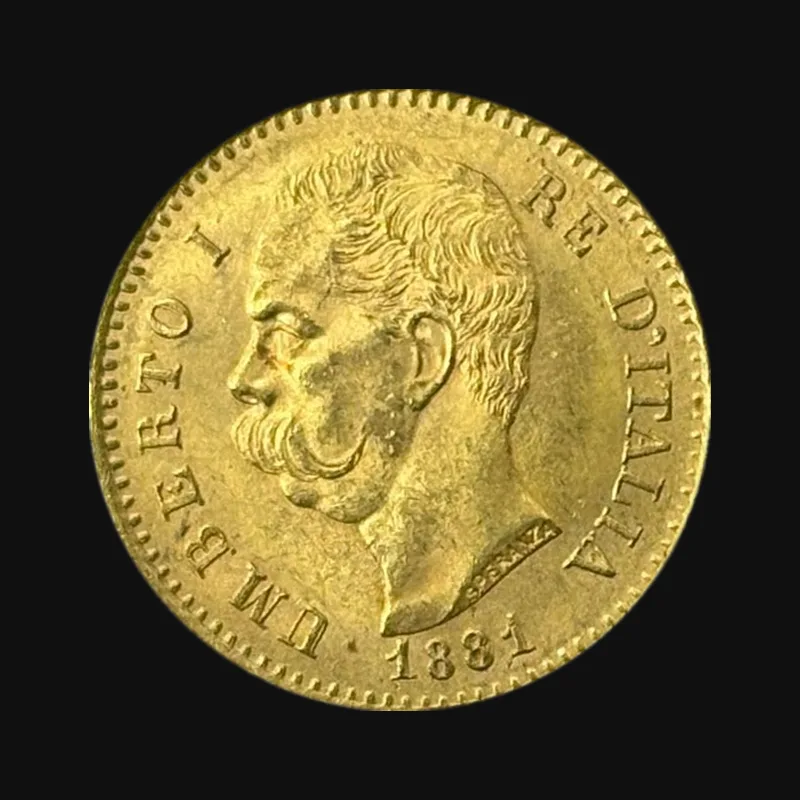
- Which ruler? Leopold II and Umberto I are by far the most frequent. Leopold I, Albert I and Victor Emmanuel II turn up less often.
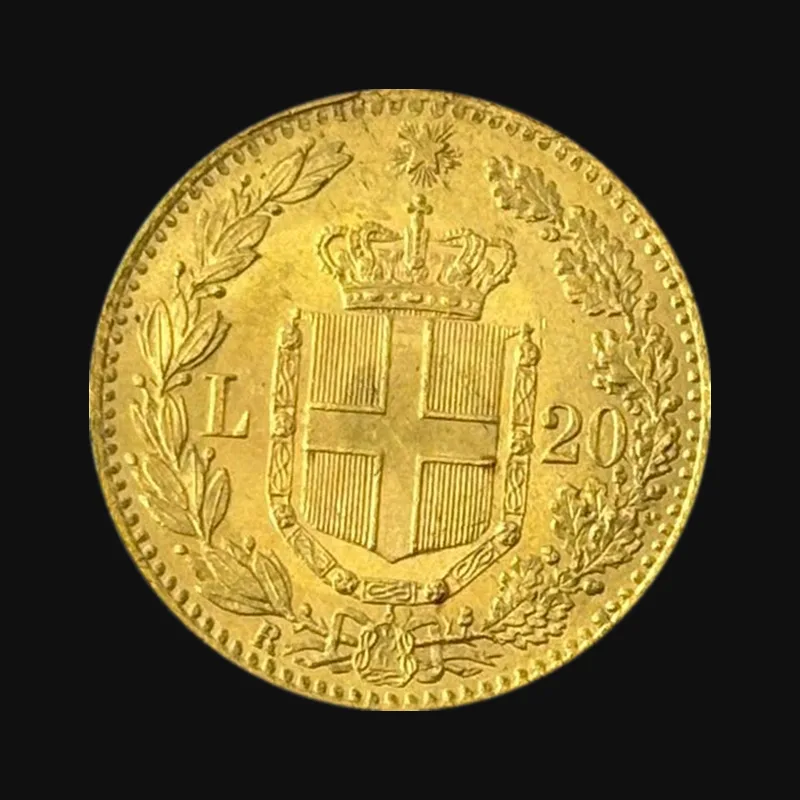
- Which year, and for Italy which mint? The letter T, M or R is on the reverse.
- Are weight and diameter right? Expect 6.45 g and 21 mm; normal wear only takes off a few hundredths of a gram.
Then store each coin on its own, in a sleeve or a case, with these details written beside it. Gold coins rubbing against one another soon pick up marks.
The dates that stand out
In Italy, rarity is concentrated at the start. The Turin 20 lire dated 1861, the year of the new kingdom, was struck in only 3,267 pieces. Under Victor Emmanuel II, the Rome mint, opened in the 1870s, has very thin dates: 1873 is very rare, 1875 does not exceed 51,000 pieces. Turin and Milan pieces of this reign add a “BN”, for Banca Nazionale, beside the mint letter. Umberto I, whose 20 lire all come from Rome, has several rare dates: 1884, 1889, 1891, 1893 and 1897, with only 9,775 pieces in 1884 according to Bdor.
In Switzerland, the Helvetia was struck only from 1883 to 1896. The year 1887 (176 pieces) and the year 1888 (4,224) are the hardest to find, and the 1893 and 1895 strikings in gold from the Gondo mine, in the Valais, number in the dozens: a minute punch placed at the heart of the shield and a paler metal give them away.
In Belgium, the millions of Leopold II coins make them common, but the Leopold I type dated 1865 and Albert I's single date, 1914, are seen less. Leopold II has two successive portraits, with a heavy beard and then a fine one, and an 1865 variety bears the faulty signature “L. WINNER”.
Counterfeits and mounted coins
The rare Italian dates are the most counterfeited, so much so that a good share of the pieces of these dates on the market are thought to be false; some old or modern copies contain gold. Beware of inconsistencies: an Umberto I with the letter T or M matches no official striking. Check the weight, the diameter, the regularity of the edge and the sharpness of the letters, following the guide (in French) reconnaître une fausse pièce.
Before 1914 these coins passed from hand to hand, then many ended up as jewellery. A spot of solder or the mark of a ring on the edge, knocks on the rim, fine scratches from cleaning all lower the grade. On the heads side, Leopold II's hair and beard, the moustache of the kings of Italy and Helvetia's diadem wear first; on the tails side, the Belgian lions, the collar around the Savoyard shield and the Swiss leaves. For a common date the effect stays small; for a rare date it counts for a lot. Our French guides on grading and cleaning coins go further.
Not to be mistaken for…
- A French 20 francs. Same module, but a French legend in the name of the emperor, the king or the Republic: compare with our pages on the Rooster and Napoleon III coins.
- A 20 lire of the Kingdom of Sardinia. Victor Emmanuel II struck them before 1861 to the same standard, without the words “REGNO D'ITALIA”.
- A 20 lire of Victor Emmanuel III, from the 20th century, with a different portrait and reverses.
- A Swiss Vreneli, struck from 1897, recognisable by the young woman's plaits and the mountains.
- A coin of another country of the same module: Greek 20 drachmai, Austro-Hungarian 8 florins (1870-1892), 20 francs of Charles III of Monaco (1878 and 1879).
From the 1865 convention to dissolution
By the early 1860s, the Swiss, the Belgians and the Italians were already using systems derived from the franc germinal. The convention concluded in Paris on 23 December 1865 with France set common rules of weight and fineness and required each state to accept the coins of the other members in its public treasuries. Greece joined in 1868. The nickname “napoléon” in France and “marengo” in Italy then applied to every 20 francs of the Union, whatever its country.
The war of 1914 stopped the circulation of gold; Belgium denounced the convention at the end of 1925 and the Union ceased to exist on 1 January 1927. The coins kept in families ever since still feed today's estates.