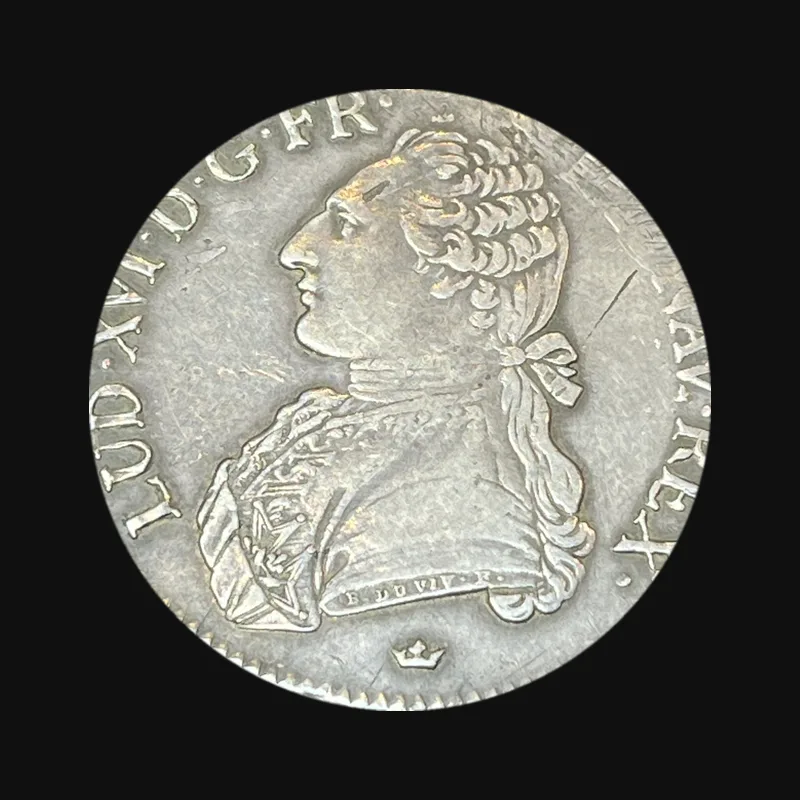
Obverse
A king in profile, with a draped, armoured or clothed bust depending on the period, surrounded by an abbreviated Latin title. Example under Louis XV: “LUD. XV. D. G. FR. ET NAV. REX”. From Louis XV onwards, the face looks to the left.
Written by the Maison Or & Bijoux Cagnes-sur-Mer team · updated
| Country | France |
|---|---|
| Alloy | Silver 917 fine, known as 11 deniers |
| Weight | 27.45 g from 1641 to 1709, then 30.59 g; settled at 29.488 g after the 1726 reform, with variations during the Regency |
| Diameter | 37 to 41 mm |
| Dates | From 1641 to 1793 |
| Legal tender value | 3 livres in 1641; 6 livres from 1726 |
| Sub-units | From the half écu down to the twentieth, depending on the reign |
| Some mints | & (Aix), MA (Marseille), M (Toulouse), A (Paris), B (Rouen), D (Lyon), BB (Strasbourg), AA (Metz), K (Bordeaux), T (Nantes)… |
| Engraving | Warin, Roettiers, Duvivier |
| Edge | Raised lettering in the eighteenth century |
| References | Gadoury 217, 229, 322, 354 (fifth écu), 356; Droulers; Davenport |
Holding a large white coin of about 40 mm, with the profile of a Louis, weighing somewhere between 27 and 30 g? It is very probably an écu, the kingdom's main silver coin for a century and a half, from Louis XIII to the fall of the monarchy. It was struck in more than thirty towns, each identified by a letter or a sign. Half écus and the small fractions, lighter, also turn up often in inheritances.
A king in profile, with a draped, armoured or clothed bust depending on the period, surrounded by an abbreviated Latin title. Example under Louis XV: “LUD. XV. D. G. FR. ET NAV. REX”. From Louis XV onwards, the face looks to the left.
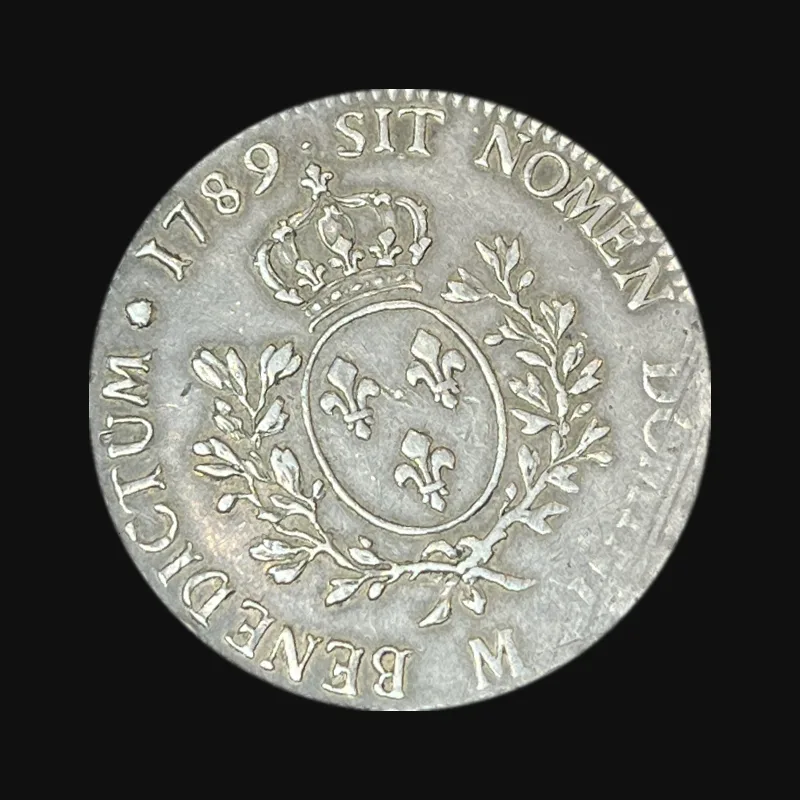
Under Louis XIV, often a cross of crowned L's or crowns; in the eighteenth century, mostly the oval shield of France, crowned, between two olive sprigs. Around it, “SIT NOMEN DOMINI BENEDICTUM” (blessed be the name of the Lord) and the year; the mint mark sits at the bottom, under the shield.
Rather than a list of types, here is a selection of date and mint pairs, from the first écu to the last, with the mintage recorded by the Droulers reference where it is known. These markers show the huge gap between a large mint and a small one: a few tens of thousands of coins on one side, several million on the other. Compare your letter and date with these milestones.
| Year | Mint | Type | Recorded mintage | Comment |
|---|---|---|---|---|
| 1643 | A, Paris | Louis XIII écu | 208,634 and 342,870 | Two privy marks, the dot and the rose, share the year |
| 1694 | A, Paris | Palms | 848,079 | Not counting the many reformed écus |
| 1709 | A, Paris | Three crowns | 7,335,848 | A year of very heavy coinage, at the new 30.59 g weight |
| 1738 | BB, Strasbourg | Olive branches | 517,925 | 6-livre écu, on the 1726 standard |
| 1754 | AA, Metz | Headband | 78,020 | Small mint, modest output |
| 1775 | A, Paris | Louis XVI, draped bust | 309,200 | First year of Duvivier's type |
| 1775 | &, Aix | Fifth écu | 23,679 | A 5.83 g fraction, rather scarce |
| 1785 | M, Toulouse | Louis XVI, draped bust | 1,205,026 | A large mint of the south |
| 1790 | MA, Marseille | Louis XVI, draped bust | 243,443 | Mint opened in 1787 in place of Aix |
| 1791 | BB, Strasbourg | Louis XVI, draped bust | 23,000 | One of the lowest mintages of the reign |
Mintages taken from the Coinvarieties page for each date, which refers to the Droulers reference; types and weights checked against Wikipedia. An indicative selection: most dates and mints are not listed.
Everything starts with the obverse legend, which gives the ruler's name: LUD. XIII, LUD. XIIII, LUD. XV or LUD. XVI. The portrait then narrows things down. Under Louis XIV, the king ages from type to type, from the short-haired child to the bewigged monarch. Under Louis XV, you move from the Regency child to the young man with a headband, then to the old head of the 1770s.
The reverse completes the picture. A cross of eight L's suggests the 1690s; olive sprigs around the shield belong to the eighteenth century, after 1726. A genius engraving tablets with the words “REGNE DE LA LOI” marks the constitutional écu of 1792-1793.
In December 1641, the first écu was set at 27.45 g of silver at 917 fine and worth 3 livres. Being struck on a screw press gave it a regular outline, which discouraged those who clipped the edges.
Between 1690 and 1709, royal finances imposed several reformations: écus went back to the mints and came out with a new design, without being melted down. The three-crowns type of 1709 raised the weight to 30.59 g. The Regency years and John Law's system then multiplied the changes.
The 1726 reform, under Cardinal Fleury's ministry, ended the disorder: 29.488 g, 6 livres, and no further change until 1793. So weigh your coin to the hundredth: a marked shortfall against the type's weight means heavy wear, clipping, a plugged hole or a forgery.
The word “écu” has been used for several coins. The gold écu au soleil, earlier than 1640, is a gold coin without a royal portrait. In the nineteenth century, the silver 5 francs were still called “écus”; they are easy to spot, with a French legend, 25 g and a post-Revolution date.
The fractions reproduce the écu's design on a smaller scale. The Louis XVI half écu weighs about 14.7 g for 30.5 to 33 mm; the fifth, about 5.83 g. Below that, tenths and twentieths are best told apart on the scales.
Some series have their own story: the so-called Flanders écus struck at Lille under Louis XIV, and the écus of Pau for Béarn. And an olive-branch écu with a Bern countermark is still a French coin, simply one that passed through Switzerland, where it was called the Laubtaler.
On a restruck écu, a few letters or part of the old design can often be made out beneath the new one. This is the mark of the reformations, not a flaw: catalogues note it and separate restruck écus from those struck on new flans.
Varieties also arise from privy marks, tiny symbols of the director and the engraver placed in the legend. In Paris, the 1643 écu thus exists with a dot or with a rose.
Forgers of the time cast the silver or covered a base metal with a thin film of silver: the coin is then too light, grainy, with soft edge letters. Modern copies betray their origin through blurred relief and a dull ring.
Wear shows on the highest points: the locks above the ear, the ribbon or laurel wreath, the cheekbone, the drapery or the embroidery of the coat. On the reverse, the pearls of the crown and the outline of the lilies gradually vanish.
Two faults come up again and again: the hole, drilled to wear the coin as a medal, and cleaning, which leaves a whitish shine and a network of fine scratches. An even toning, grey or golden, is an asset. Do not rub anything; our numismatists can look at the coin during a free valuation.
Cagnes long stood on the edge of the kingdom: from 1388, when Nice passed to Savoy, the Var separated Provence from the County of Nice, and the town became an important border post. On the Provençal bank, people paid in royal coin, and the mint of Provence was at Aix, recognisable by the & sign. It struck écus and their fractions until it was abolished in 1786: Coinvarieties records, for instance, 23,679 fifth écus dated 1775 &. Écus of that period still come out of local estates and can be shown at the shop to have their type identified.
By its mint sign, an ampersand (&), placed on the reverse below the shield. You will not find it after 1786, when the mint was abolished.
No. That was how the Roman numeral of Louis XIV was written at the time, with four I's. The portrait and reverse then give the precise type.
Yes, for its history and its metal, even if the hole weighs on its grade. Do not fill it: show it as it is to a numismatist.
Tilt it under raking light: fine parallel scratches and an overly bright white betray cleaning. An even toning, on the other hand, indicates a coin left alone.
No. The legal weight goes from 27.45 g (1641-1709) to 30.59 g, varies during the Regency, then settles at 29.488 g in 1726.