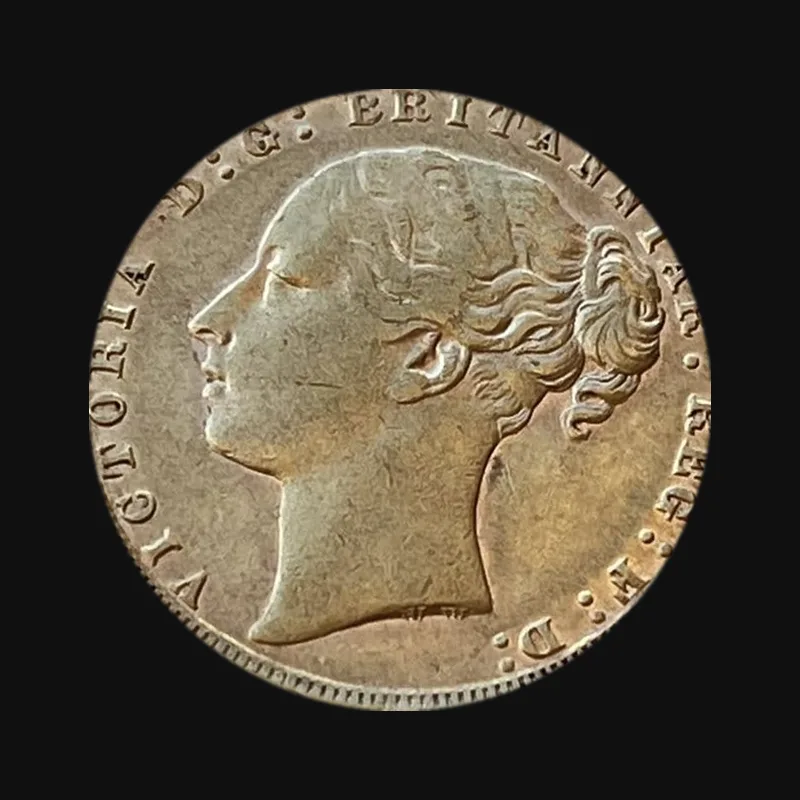
Obverse
Bust or head of the monarch, with Latin titles cut down to abbreviations. On George V pieces: “GEORGIVS V D G BRITT OMN REX F D IND IMP”. On Victoria's first ones: “VICTORIA DEI GRATIA”, nothing more.
Written by the Maison Or & Bijoux Cagnes-sur-Mer team · updated
| Country | United Kingdom |
|---|---|
| Fineness | 916.7‰ (22-carat gold) |
| Sovereign weight | 7.988 g |
| Half weight | 3.994 g |
| Fine gold | 7.322 g (sovereign) and 3.66 g (half) |
| Diameter | 22.05 mm (sovereign) and 19.30 mm (half) |
| Issued | From 1817 to the present, with breaks |
| Marks | London: none. S for Sydney, M for Melbourne, P for Perth, C for Ottawa, I for Bombay, SA for Pretoria |
In France it is often called the “English sovereign”: the United Kingdom's gold pound, minted since 1817 in 22-carat metal, with a half sovereign of the same design. Produced in London and in six distant mints, it served as reserve money on several continents. To know what you are holding, read the portrait, the date, then any mint mark.
Bust or head of the monarch, with Latin titles cut down to abbreviations. On George V pieces: “GEORGIVS V D G BRITT OMN REX F D IND IMP”. On Victoria's first ones: “VICTORIA DEI GRATIA”, nothing more.
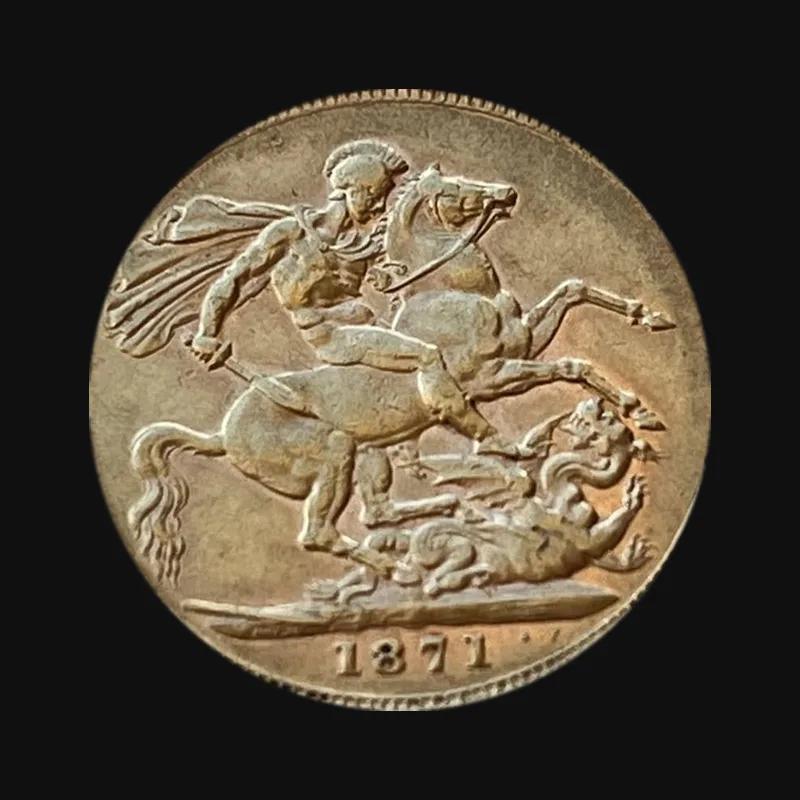
The best-known motif is Saint George slaying the dragon, Pistrucci's work, recognisable by the letters “B.P.” close to the date; it decorates the sovereign from 1817 to 1825 and without a break since 1871. The second motif, a crowned royal shield inside a laurel wreath, fills the years in between and stays in use in London until 1874, in Australia until 1887 and on the half sovereign until 1893.
The table covers the sovereign only. Before using it, find the letter: on the Saint George reverse it is struck just above the date, on the ground line; on the shield reverse, under the laurel wreath; some early Australian Saint George pieces carry it on the obverse, below the portrait. No letter, no doubt: London.
| Year | Letter | Mintage | Comment |
|---|---|---|---|
| 1817 | none | unknown | The very first sovereign. |
| 1819 | none | 3,574 | The legendary date of the series. |
| 1871 | S | 2,814,400 | Sydney drops its own model for London's. |
| 1872 | M | unknown | Melbourne's first date. |
| 1879 | none | unknown | Few pieces, often tired. |
| 1899 | P | unknown | Perth's first date. |
| 1908 | C | unknown | Ottawa joins the series. |
| 1916 | C | about 6,000 | The date to look for in Canada. |
| 1917 | none | about 1,000,000 | Rare twentieth-century London piece. |
| 1918 | I | 1,294,372 | Bombay, struck from August 1918 to April 1919. |
| 1920 | M | 530,266 | Rare, largely remelted. |
| 1920 | S | 360,000 | Extremely rare: almost all melted. |
| 1923 | SA | 406 to 423 | Pretoria opens, mintage debated. |
| 1925 | none | unknown | Also struck in 1949, 1951 and 1952 with this date. |
| 1926 | S | 1,031,050 | Sydney's last year, very hard. |
| 1931 | M | 57,809 | Melbourne's last year. |
| 1932 | SA | 1,066,680 | End of the circulating sovereign. |
| 1974 | none | unknown | Lasting return of striking, after the 1969-1973 halt. |
Mintage sources: Wikipedia (1819, Bombay) and goldsovereigns.co.uk mint by mint, compared with Heritage lot notes. Be careful with official figures: a large share of Australian sovereigns was melted, so a big mintage can hide a rare date. Partial list.
A shield sovereign always belongs to Victoria's reign. If it has the young head and no letter, it was struck in London between 1838 and 1874; with an S or M under the laurel wreath, it comes from Australia, where the shield stayed in service until 1887. In the nineteenth century London and the Australian mints thus struck both reverses at the same time.
Saint George, on the other hand, dates nothing by itself: it was used at the start (1817-1825) and again since 1871. The portrait then decides. The young Victoria, the Jubilee head (1887-1893) and the veiled old head (1893-1901) are easy to tell apart; Edward VII and George V, both bearded, are told apart by the legend, EDWARDVS or GEORGIVS.
Two cases stand out. The Sydney sovereign of 1855 to 1870 has neither reverse but a wreath with “SYDNEY MINT AUSTRALIA” and “ONE SOVEREIGN”. And the half sovereign had to wait until 1893 for Saint George, and even then without Pistrucci's initials.
The 1816 Act gave the United Kingdom a reference gold coin and ended the guinea. The early years were paradoxical: the British public kept its one-pound notes and a good part of the new coins was melted, notably, according to Robert Peel as quoted by Wikipedia, to feed the gold used in France.
Over the nineteenth century the sovereign reached Portugal, Brazil and the whole Empire. The Australian mints worked so hard that around 1900 some 40 per cent of the sovereigns in British circulation had come out of Sydney, Melbourne or Perth. Ottawa joined in 1908.
August 1914 ended gold in everyday British payments. Striking went on for some years outside London, as far as Pretoria in 1932. Revived in 1957 to satisfy Middle Eastern demand for gold, the sovereign paused from 1969 to 1973 before resuming in 1974. Other British and foreign coins appear in the foreign coins section (in French).
Step one, consistency. Does the portrait really match the year? Was that mint letter used for that date? One inconsistency is enough to rule the piece out. Step two, the design: genuine sovereigns have crisp outlines, a detailed mane and sharp lettering; copies show blunted relief.
Step three, the surface and the edge. An irregular grain, tiny bubbles or milling whose grooves vary in spacing point to a cast piece. Only at step four comes measuring: diameter and weight must be right, but they prove nothing.
That last caution comes from history. Between the 1950s and the 1970s, forgers in Syria, Italy, Switzerland and Lebanon produced sovereigns of the correct fineness for the markets of Greece and the Middle East, where the coin was still in high demand. More detail in spotting a fake coin, a guide in French.
Wear is read first on Saint George: his helmet, the horse's mane, the rider's leg and the animal's muscles round off with circulation, then the dragon loses its tail and scales. On a shield reverse, the quarters of the arms and the pearls of the crown play that part.
On the obverse, study the beard and ear with George V, the cheek with Edward VII, the ribbon and bun with the young Victoria. Many sovereigns also bear the scars of former jewellery: a solder point, a removed loop, a filed edge.
Keep each piece separately, in a PVC-free sleeve, and do not rub it: the guide cleaning a coin shows the damage done by cleaning, and coin grades presents the scale numismatists use (both in French).
On this coast the British presence goes back a long way. From the second half of the eighteenth century, wealthy English visitors came to spend the winter in Nice, a few kilometres from Cagnes-sur-Mer. Around 1820 a very harsh winter further north drew beggars to the coast, and the English colony suggested employing them to lay a path along the sea: the Reverend Lewis Way and members of the Anglican church of Holy Trinity paid for it. The people of Nice called it the “Camin deis Anglés”, before it became, after 1860, the Promenade des Anglais. Nothing shows that today's sovereigns descend from those winter visitors; they simply turn up fairly often in estates across the Alpes-Maritimes, along with the Rooster 20 francs.
Both are heard. The coin is British, struck by the Royal Mint and its overseas branches, but French usage readily speaks of the English sovereign.
Not necessarily. The shield belongs to Victoria's reign, but Saint George existed before it (1817-1825) and alongside it, from 1871 to 1887, depending on the mint.
Early Australian Saint George sovereigns have it on the obverse, below Victoria's portrait. On shield reverses, under the laurel wreath.
It keeps at least its gold, but loses most of its numismatic interest. For a rare date, the gap with an intact piece is significant.