Panthéon or commemorative: the first sort
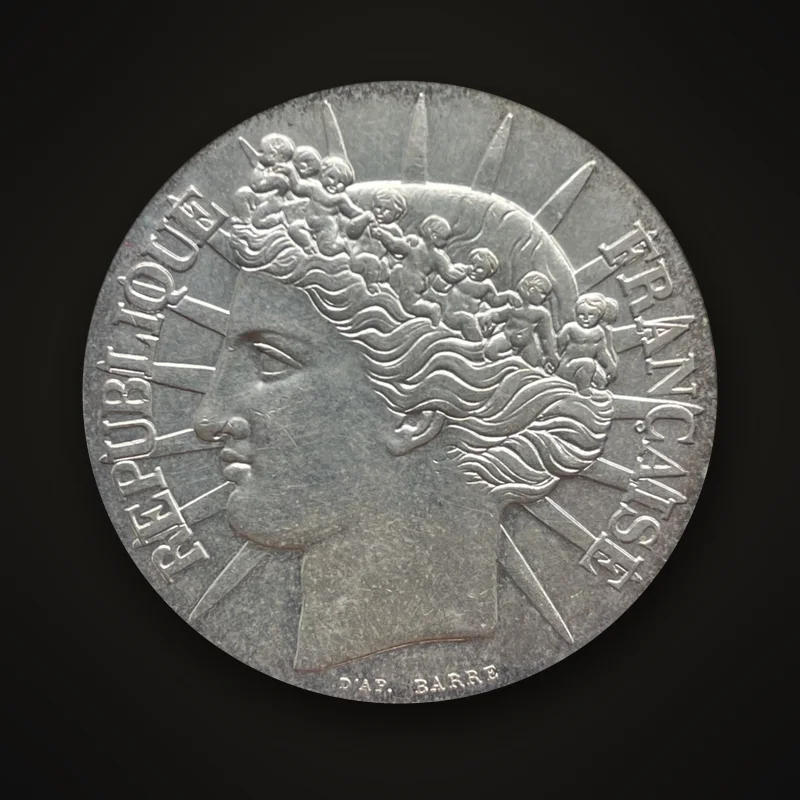
Turn the coin to its picture side. If you see a columned building topped by a dome, it is the standard type, the Panthéon: note the year, as mintages vary enormously from one date to the next. If you see a face, a foreign monument or a scene, it is a commemorative: identify the subject, as each subject exists for one year only.
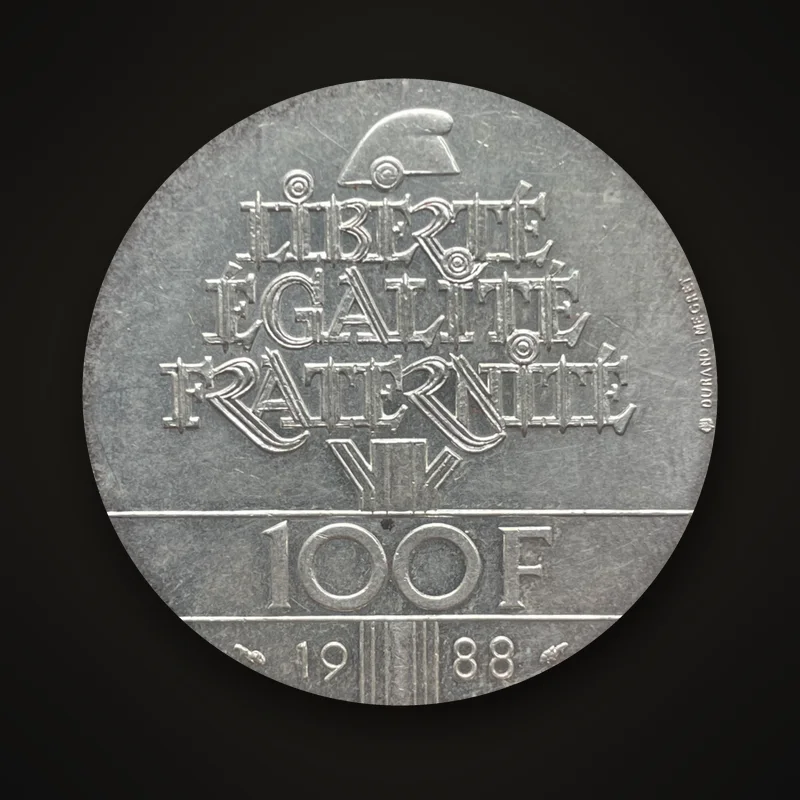
The fourteen commemoratives tell a short history of France in silver: scientists and writers (Curie, Zola, Descartes, Malraux), Europe with Jean Monnet, founding kings (Charlemagne, Clovis), then the great anniversaries of 1789 and 1944-1945. Between 1986 and 1988, three coins follow the motto: the Statue of Liberty, La Fayette for Equality, then Fraternity.
Not to be confused with:
- The 100 francs Cochet of the 1950s, an old-franc coin in base metal.
- The 10 francs and 50 francs Hercule, also 900‰ but heavier (25 g and 30 g) and earlier.
- Coins from Monaco in the name of Rainier III, which do not belong to this French series.
Privy marks, collector issues and fakes
Dolphin or bee. The Chief Engraver's symbol changes in 1995: the dolphin gives way to the bee. On the Panthéon, this detail alone separates two periods of the same type.
Special finishes. Alongside the circulation strike, the Paris Mint issued several subjects in proof, uncirculated or brilliant uncirculated finish, in small numbers: 1,000 Marie Curie in proof, 5,000 Zola in proof and 50,000 uncirculated, 25,000 La Fayette in brilliant uncirculated. The Panthéon exists in proof from 1991 to 2001. These coins have a mirror-like or perfectly crisp field; the case and original paperwork belong with the coin.
Coins outside the series. Trials, struck in a few hundred or a few thousand pieces per subject, bear the word ESSAI (trial). Collector 100 francs sold in sets, sometimes in gold or in a different size (Louvre 1993, Marie Curie in gold), are separate issues.
Fakes. Lighter than 15 g, sometimes drawn to a magnet, they show soft relief. The wide plain field quickly reveals the pitted surface of a cast coin. The full method is in how to spot a fake coin.
Often in excellent condition: what makes the difference
These coins were hardly used for shopping. Wear is therefore rare; it is storage marks that separate two examples.
- The Panthéon: check the top of the dome, the pediment and the relief of the columns, the first places to soften.
- Portraits: on Curie, Zola, Descartes, Monnet or Malraux, the cheekbone, the bridge of the nose and the locks of hair betray the slightest rubbing.
- The field: wide and smooth, it records every contact with another coin. The plain edge also shows knocks.
- Spots: black or iridescent rings, especially in old plastic bags and paper rolls.
Do not use any silver polish: it leaves a haze of micro-scratches visible under raking light. For the terms used, see the grading guide.
A series born in 1982, ended by the euro
In the early 1980s, franc coins were made of nickel, aluminium bronze or steel. A silver 100 francs was therefore an exception. The Panthéon designed by Jean-Claude Dieudonné became the standard type in 1982. Too heavy for a purse, the coin was mostly kept: from 1987, the Panthéon never exceeded 100,000 coins a year.
In 1984, the Paris Mint launched an annual commemorative in the same size. The pace lasted until 1997: fourteen subjects, mintages of 4 to 5 million in the 1980s, then under 2 million from 1993, and barely half a million for Malraux.
The euro brought the story to a close. Until 2001, only collector sets still received Panthéon coins. Franc coins lost legal tender status in February 2002 and could no longer be exchanged at the Banque de France after February 2005. For the rest of the period, see francs from 1960 to 2001 and silver coins.