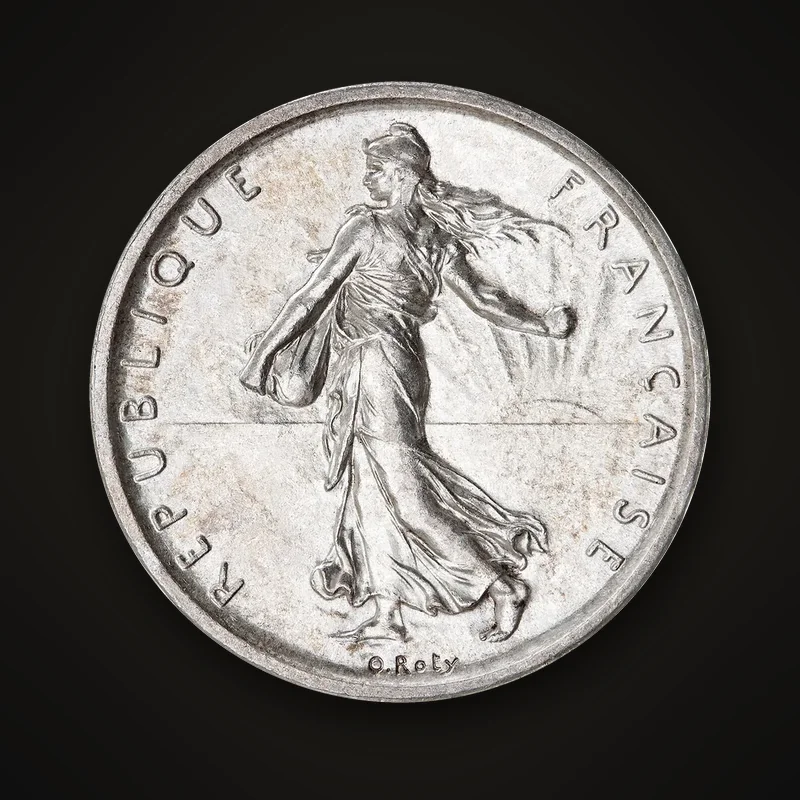
Obverse
Oscar Roty's design revived: a woman in a Phrygian cap, in profile, strides to the left, sowing seed by hand. The legend reads “REPUBLIQUE FRANÇAISE” (French Republic), with the signature “O. ROTY”.
Written by the Maison Or & Bijoux Cagnes-sur-Mer team · updated
| Country | France |
|---|---|
| Metal | Silver, 835‰ fine |
| Weight | 12 g |
| Fine silver | About 10 g |
| Diameter | 29 mm |
| Edge | Lettered in relief |
| Years struck | 1960 to 1969, trials and pre-series dated 1959 |
| Mint | Paris Mint (no mint letter) |
| Engraver | Oscar Roty (1897 design) |
| Privy marks | Cornucopia and owl |
| Demonetised | 1980 |
The flagship coin of the 1960 new franc, the 5 francs Semeuse (Sower) is the last large silver coin the French carried in their pockets every day. It is recognised by its edge bearing the republican motto and by its weight of 12 g. The years 1960 to 1964 were struck in huge numbers; the last three dates, 1967 to 1969, are much less frequent.
Oscar Roty's design revived: a woman in a Phrygian cap, in profile, strides to the left, sowing seed by hand. The legend reads “REPUBLIQUE FRANÇAISE” (French Republic), with the signature “O. ROTY”.
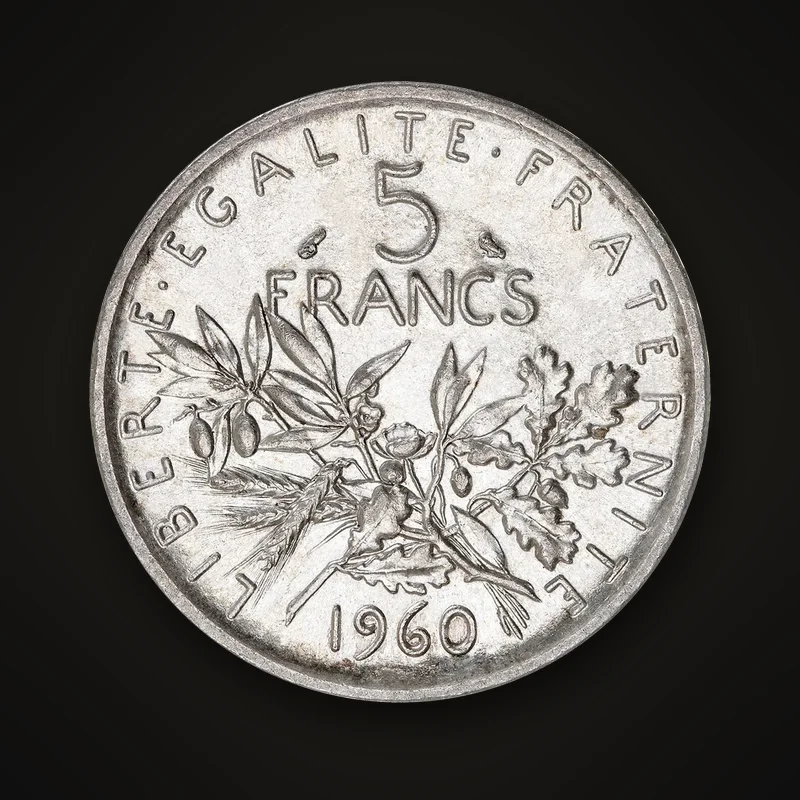
“5 FRANCS” stands above a sheaf of olive, oak and wheat branches. Below the sheaf is the year; around the edge, “LIBERTE EGALITE FRATERNITE”. On either side of the date are two small symbols: on the left the cornucopia of the Paris Mint, on the right the owl of Chief Engraver Raymond Joly.
Eleven dates in all, one of which never circulated. Remember the break of 1965: before it, tens of millions of coins a year; after it, a few million, then under one million from 1967 to 1969. The 1968 comes last with the smallest mintage. Any coin dated 1959 falls outside the circulation series and should be shown to a numismatist.
| Year | Mintage | Remarks |
|---|---|---|
| 1959 | not known | Trials (large 5, small 5) and pre-series, not released into circulation. |
| 1960 | 55,082,000 | First year and largest mintage. |
| 1961 | 15,630,000 | Common. |
| 1962 | 42,500,000 | Very common. |
| 1963 | 37,936,000 | Very common. |
| 1964 | 32,403,600 | Very common. |
| 1965 | 5,156,000 | Start of the fall in mintages. |
| 1966 | 5,017,171 | Common. |
| 1967 | 702,305 | Low mintage. |
| 1968 | 357,000 | Lowest mintage of the series. |
| 1969 | 504,050 | Low mintage, last year in silver. |
Figures from the French Wikipedia article on the coin, identical to those of BDOR, giving 195,288,126 coins in total. The 1959 trials and pre-series are described inconsistently from one source to another, so no mintage is given. NGC publishes different figures for 1967 and 1968, not used here.
In a drawer, the silver 5 francs Semeuse almost always sits next to coins that look like it. Here is the quickest order for sorting:
Another possible mix-up: the silver Semeuse 50 centimes, 1 franc and 2 francs from before 1920, with the same design but smaller and lighter. Larger, the 10 francs Hercule of 1965 to 1973 is the other silver coin of the period. The full picture of the period is on francs from 1960 to 2001.
Before release. The Paris Mint prepared the coin in 1959 by trialling two versions of the numeral 5 on the reverse, one large, one small. The small one won. A pre-series was also struck that year. These coins dated 1959 were never used in payment, and their exact number is still debated.
The last three dates. In 1967, 1968 and 1969, output fell below one million. A coin from these years, especially one that saw little circulation, interests collectors far more than a 1962 or a 1963, which turn up by the handful.
Counterfeits. Fakes were made while the coin was still in use. They often give away their alloy: weight under 12 g, edge letters that are smudged, badly spaced or missing, a greasy feel. A magnet should have no effect. Balanced on a fingertip and tapped lightly with another coin, a silver 5 francs gives a clear, lasting ring. To go further, see how to spot a fake coin.
Unlike the 10 and 50 francs Hercule, often put aside as soon as they came out, the 5 francs Semeuse was genuinely used for ten years. Worn examples are therefore the rule. A few precise areas show the grade:
On a common date, a collector will see little difference between two average grades. On 1967, 1968 or 1969, a coin without wear clearly stands out. Leave the toning as it is: silver polish leaves micro-scratches that cannot be undone. A detailed method is in the grading guide and the precautions in cleaning a coin.
On 1 January 1960, the new franc replaced the old one at a rate of 100 to 1. To give this currency a familiar face, the authorities brought back the Sower that Oscar Roty had created in 1897 for the small silver coins of the Third Republic. It appeared on the nickel 1 franc, then the ½ franc, and above all on the 5 francs, struck in silver at the same 835‰ standard as its predecessors.
The choice of silver did not last. During the 1960s, the metal grew dearer and the silver in the coin came close to the amount stamped on it: the risk was that the public would keep it, or even melt it down. Output fell from 1965 and the Paris Mint switched to nickel in 1970, keeping the same design. The silver coins gradually left circulation before being demonetised in 1980. They now belong to collectors; you will find them on the page on silver coins.
The coin comes from the Paris Mint: no mint ever operated on the Côte d'Azur. In drawers in the area, between Nice and Antibes, it is often mixed with the Monaco 5 francs bearing the portrait of Rainier III, struck in the 1960s in 835‰ silver, with the same 12 g weight and the same 29 mm diameter. The legend settles the question: “REPUBLIQUE FRANÇAISE” on one, the prince's name on the other. In Cagnes-sur-Mer, a free assessment lets you do this sorting with a numismatist.
Look at the date and the edge. A coin dated 1960 to 1969, with the motto in raised letters on the edge, is silver. A reeded edge and a date from 1970 onwards mean the nickel version.
They are trials or pre-series pieces, struck before the official release in 1960. They never circulated and deserve to be examined by a numismatist.
No. Each of those years was struck in more than 15 million coins. The low-mintage years are 1967, 1968 and 1969.
No. The Rainier III 5 francs has the same weight and silver standard, but it is a Monegasque coin, with its own design and its own mintages.