Sorting a batch of 10 francs Hercule
These coins rarely come alone: they turn up by the dozen, in bank rolls, biscuit tins or plastic tubes. Sorting in three steps saves time.
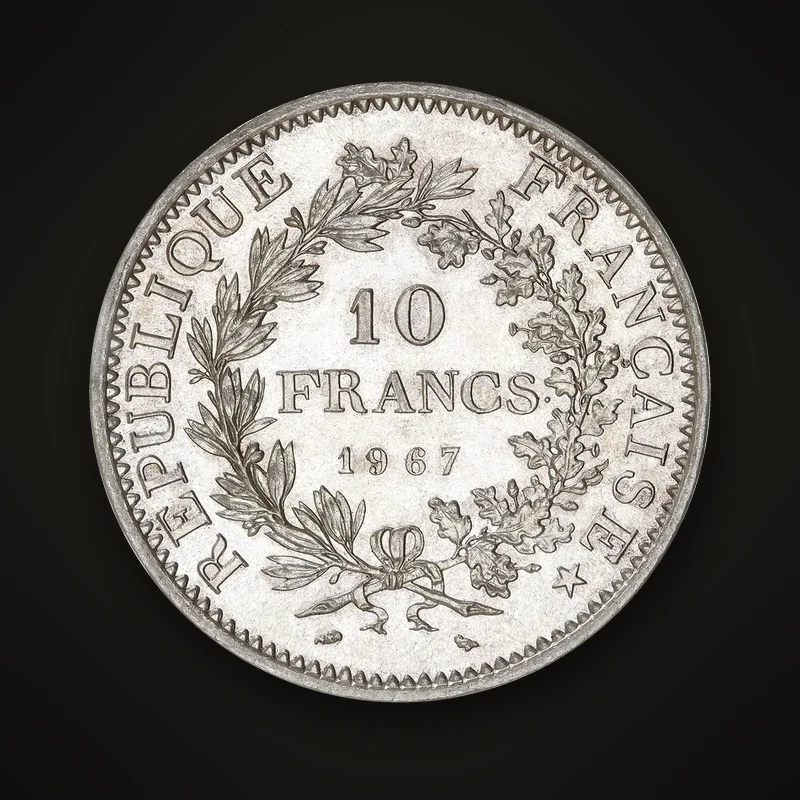
- Read the date on the reverse, below the wreath. The years 1965 to 1968 and 1970 make up most of any batch. Put 1969, 1971, 1972 and 1973 to one side.
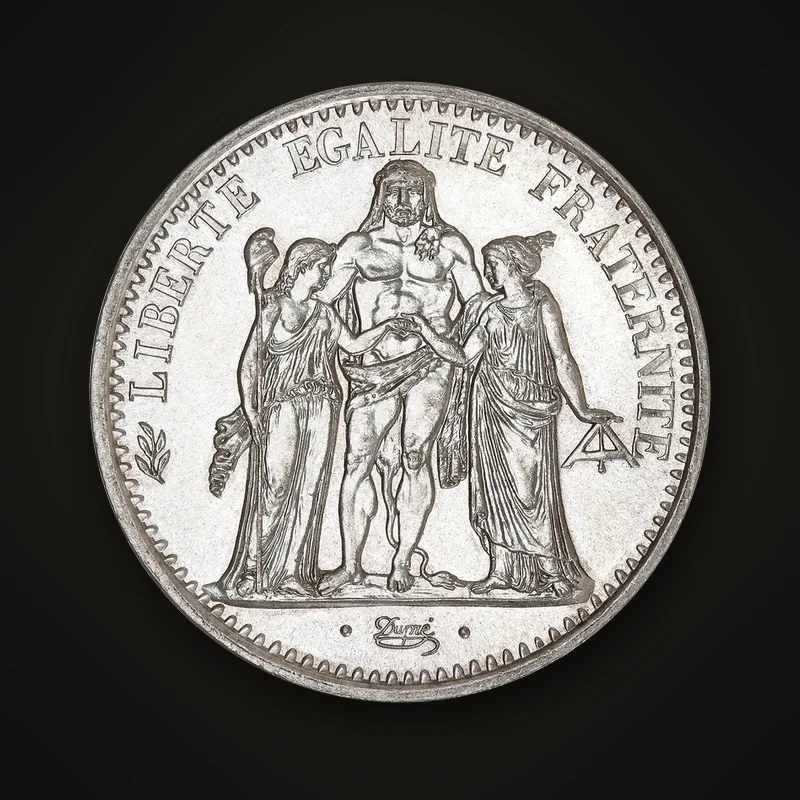
- Look for 1964. A coin of that year never circulated: it is either the trial, which bears the word ESSAI, or the pre-series of 131 coins, which does not. On the pre-series, Liberty's pike ends in a hand of justice instead of the cap, Equality has no bun and the signature sits between two stars.
- Check the reverse legend with a magnifying glass: an accent on the first E of REPUBLIQUE marks a variety listed separately, assigned to 1967 by Le Franc.
Leave the coins as they are, even if tarnished. A numismatist can do this sorting with you during a free assessment.
Not to be confused with
- The 50 francs Hercule (1974-1980): same design, but 41 mm and 30 g, with “50 FRANCS” on two lines.
- The 19th-century 5 francs Hercule écu: the same Dupré group and, a classic trap, the same size (25 g of 900‰ silver, 37 mm). The difference shows on the reverse, with “5 FRANCS” and a 19th-century date, and on the edge, which carries a lettered inscription instead of emblems. See the 5 francs écus.
- The silver 5 francs Semeuse (1960-1969): the other silver coin of the new franc, smaller, with Oscar Roty's Sower.
- Copies: reproductions in brass or nickel-plated steel, sometimes with common dates. They give themselves away by a weight well off 25 g, a reaction to a magnet or an edge with blurred emblems.
If in doubt, kitchen scales that read to the gram and a fridge magnet are enough for a first check. The rest is explained in how to spot a fake coin.
Reading wear on the Hercules group
As they did not circulate much, most coins show little wear. What separates an ordinary coin from a collector's coin then comes down to a few precise areas.
- Hercules: his chest and forward knee are the highest points. Once they turn flat and shiny, the coin has circulated.
- The two women: look at the folds of their dresses and the modelling of the faces, which fade next.
- The reverse wreath: the veins of the leaves go before the numerals.
- The large smooth fields: they keep the small scratches left by loose coins rubbing together.
Under an angled lamp, a coin rubbed with household cleaner shows a network of fine lines and an even sheen, without the original lustre. The damage cannot be undone. Grades are described on the grading guide, and the mistakes to avoid in cleaning a coin.
From the new franc to the coin kept in a drawer
The Hercules group goes back to the Revolution: Augustin Dupré drew it in 1794 for the first coins in francs. It returned on the 5 francs écus of the Second and Third Republics.
Early in the Fifth Republic, after the 1960 new franc reform, the Paris Mint brought Hercules back for a silver 10 francs, trialled in 1964 and released in 1965. But silver soon became dearer. The French preferred to keep these large coins, and striking stopped after 1973, with falling mintages in the final years.
From 1974, a 10 francs in base metal took over, and the Hercules design moved to the silver 50 francs. After 1975, some of the coins were melted down. The 10 francs Hercule was demonetised in 1980. Its place in the coinage of the time is described on the page on francs from 1960 to 2001.