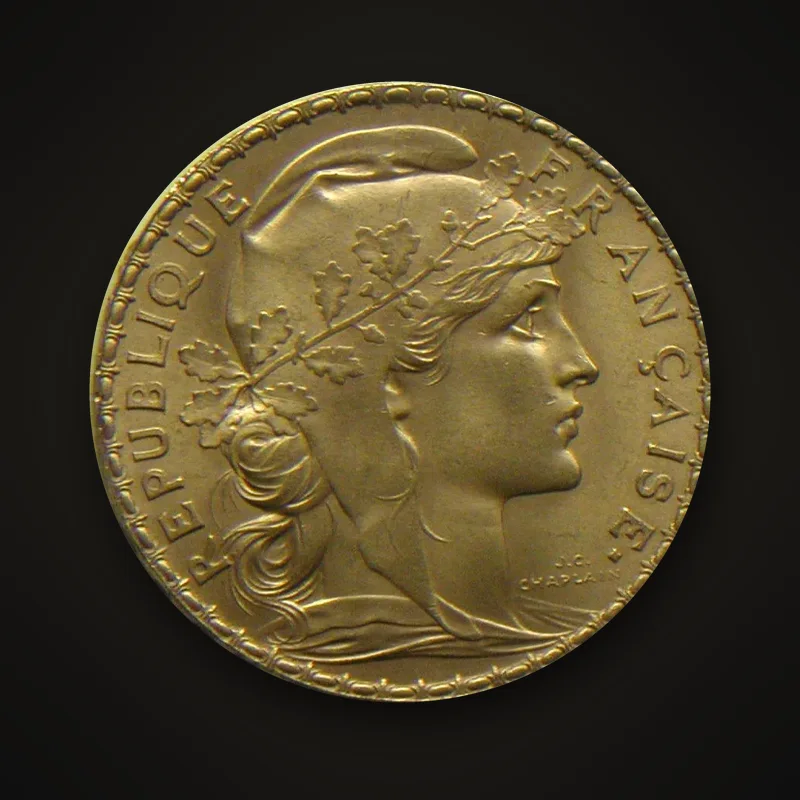
Obverse
Head of Marianne facing right, her Phrygian cap adorned with an oak wreath, with the inscription “RÉPUBLIQUE FRANÇAISE” (French Republic) following the rim.
Written by the Maison Or & Bijoux Cagnes-sur-Mer team · updated
| Country | France |
|---|---|
| Metal | Gold, 900‰ fine; 897.3‰ gold and 2.7‰ silver on the 1951-1960 restrikes |
| Weight | 6.45 g (6.4516 g) |
| Fine gold | 5.806 g |
| Diameter | 21 mm |
| Thickness | 1.30 mm |
| Edge | Lettered in relief (two types) |
| Engraver | Jules-Clément Chaplain |
| Years struck | 1899-1914; 1921 batch dated 1914; 1951-1960 restrikes dated 1907-1914 |
| Mint | Paris Mint, no letter |
| Original mintage | 117,448,888, of which 43,034,473 of the first type and 74,414,415 of the second |
| 1951-1960 restrikes | 37,483,500 |
| References | Le Franc F.534 (edge “Dieu protège la France”) and F.535 (edge “Liberté égalité fraternité”) |
With Marianne in her Phrygian cap and its upright rooster, the 20 francs Coq (Rooster) is the French gold coin of the early 20th century. Struck from 1899 to 1914, it was made again by the million between 1951 and 1960 bearing the dates 1907 to 1914. That is why it turns up so often: most examples are common, and only a few years and well-preserved coins interest collectors.
Head of Marianne facing right, her Phrygian cap adorned with an oak wreath, with the inscription “RÉPUBLIQUE FRANÇAISE” (French Republic) following the rim.
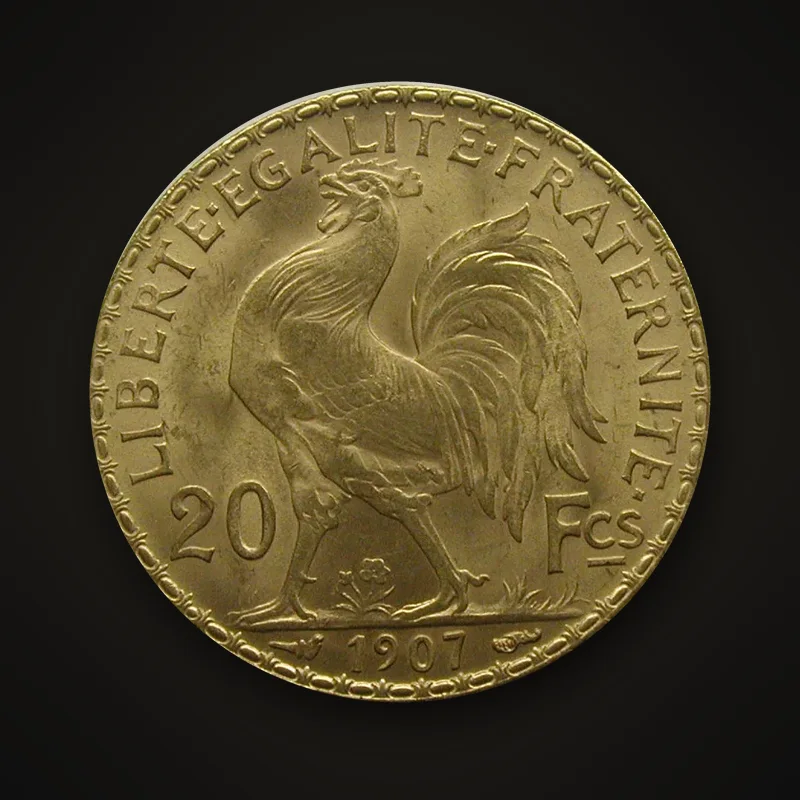
A standing rooster facing left, with the 20 francs denomination and the date, below the motto “LIBERTÉ ÉGALITÉ FRATERNITÉ” as the legend. There is no mint letter.
A date from 1899 to 1906 guarantees a coin struck at the time. For 1907 to 1914, the figure in the table counts only the original coins: restrikes also carry these dates. The years that draw attention are, in order, 1900, 1899, 1902 and 1901.
| Year | Edge | Original mintage | Remarks |
|---|---|---|---|
| 1899 | Dieu protège la France | 1,500,000 | Launch year; variant on matt flan |
| 1900 | Dieu protège la France | 605,982 | Smallest mintage; 9,443 additional coins on matt flan |
| 1901 | Dieu protège la France | 2,643,350 | Low mintage for the series |
| 1902 | Dieu protège la France | 2,393,707 | Low mintage for the series |
| 1903 | Dieu protège la France | 4,405,175 | Common |
| 1904 | Dieu protège la France | 7,705,674 | Common |
| 1905 | Dieu protège la France | 9,158,132 | Common |
| 1906 | Dieu protège la France | 14,613,010 | End of the first edge |
| 1907 | Liberté égalité fraternité | 17,715,935 | Highest mintage; date reused in 1951-1960 |
| 1908 | Liberté égalité fraternité | 6,721,325 | Date reused in 1951-1960 |
| 1909 | Liberté égalité fraternité | 9,636,955 | Date reused in 1951-1960 |
| 1910 | Liberté égalité fraternité | 5,779,072 | Date reused in 1951-1960 |
| 1911 | Liberté égalité fraternité | 5,346,044 | Date reused in 1951-1960 |
| 1912 | Liberté égalité fraternité | 10,331,805 | Date reused in 1951-1960 |
| 1913 | Liberté égalité fraternité | 12,163,138 | Date reused in 1951-1960 |
| 1914 | Liberté égalité fraternité | 6,720,141 | Includes 202,359 coins made in 1921; date reused in 1951-1960 |
Figures from French Wikipedia, which relies on Le Franc, cross-checked with BDOR. The only discrepancy is 1900, which BDOR gives as 615,425, a total adding normal coins and matt flans. The 37,483,500 restrikes come on top, and none of the sources consulted breaks them down by date.
The Rooster arrived in 1899, when the Third Republic gave up the 20 francs Genius for a new design by Jules-Clément Chaplain. The weight and fineness stayed as fixed in 1803: only the image changed. In 1907, the edge switched from “DIEU PROTÈGE LA FRANCE” to the republican motto, two years after the law separating the Churches and the State.
The 1914 war brought everything to a halt. Gold left people's purses, striking stopped after 1914 and the Rooster became a coin to keep rather than spend. The story did not end there. In 1921, the State made another 202,359 coins dated 1914. Then, from June 1951 to 1960, the Paris Mint brought the old dies back into service and produced 37,483,500 coins dated 1907 to 1914. According to French Wikipedia, the aim was to influence the free gold market. They are known as the “Pinay restrikes”, after the head of government who took office in 1952.
Its production thus spans the whole first half of the 20th century, long after gold had ceased to be money. For what came next in French coinage, see coins of the Third Republic and francs from 1960 to 2001.
Start with the date on the reverse, below the rooster. Then roll the coin between two fingers to read the edge. The two must match: 1899 to 1906 with “DIEU PROTÈGE LA FRANCE”, 1907 to 1914 with the motto. A 1903 with the motto on the edge, or a 1911 with “DIEU PROTÈGE LA FRANCE”, never existed.
For a date from 1907 to 1914, the question of when it was struck remains. A 1950s restrike is not a counterfeit: same mint, same dies, same weight. Its gold is just slightly less pure, 897.3 thousandths with 2.7 thousandths of silver, which sometimes gives it a reddish tint. It also circulated little, hence an often very fresh look.
These clues remain unreliable: toning and lighting change the colour, and some original coins stayed new in bags. Only an analysis of the alloy can settle it. In terms of coins produced, restrikes make up about a third of the Roosters dated 1907 to 1914; the proportion among coins surviving today is not known.
The true rarities of the series are the matt flan coins of 1899 and 1900, with a grainy surface and no lustre, prepared for collectors. The ordinary 1900, with its 605,982 coins, comes next, followed by 1899, 1902 and 1901. The 202,359 coins of 1921 carry the date 1914 and cannot be told apart from the others. Trials dated 1898 are reported, but they do not come out of family drawers.
Such a widespread coin has tempted forgers, sometimes using gold of the correct fineness. The usual flaws: Marianne's locks without relief, a blurred rooster's plumage, a fuzzy beaded border, edge letters of uneven height. Three simple measurements rule out many fakes: 6.45 g (a worn coin loses a few hundredths, no more), 21 mm in diameter and 1.30 mm thick. The full method is in the guide to spotting a fake coin.
On the Marianne side, the first relief to flatten is the hair above the forehead, with the oak leaves on the cap. Then come the cheek and the rim of the cap. As long as the locks are separate and the veins of the leaves can be read, the coin stays at Very Fine (TTB in French grading); once the hair is just a smooth patch, it drops to Fine (TB).
On the rooster side, watch the breast, the most prominent part, then the wing and the comb. An Extremely Fine (SUP) example keeps every feather on the breast sharply defined.
The Rooster has wide bare fields around the bird and behind the head. They record the slightest rubbing: knocks, fine scratches, nicks on the edge. Many coins, original and restruck alike, sat in bags and bear these marks without real wear; they are usually graded Extremely Fine (SUP) rather than Uncirculated (FDC). Do not try to make them shine: see why not to clean a coin and the grading guide.
The gold 10 francs Rooster uses the same design on a smaller scale: 19 mm and 3.22 g. The 20 francs Genius, its predecessor until 1898, shows a winged figure and the letter A. The 20 francs Ceres and the Napoleon III 20 francs belong to the 19th century and also carry a mint letter.
Another source of confusion: 20th-century silver coins with the effigy of the Republic, such as the 5 francs Semeuse or the 10 and 20 francs Turin. Their colour and diameter are enough to rule them out. Finally, a 1950s restrike is not a fake: it is an official coin, simply struck later than its date.
One last, rarer trap: some foreign gold coins of the same period have exactly the same weight and diameter, because their countries followed the same standard. Their legend, which is not “RÉPUBLIQUE FRANÇAISE”, is enough to identify them.
When the Rooster entered circulation in 1899, Nice and its former county had been French for almost forty years: from Menton to Antibes, the Côte d'Azur then paid in francs like the rest of the country. The neighbouring Principality of Monaco kept its own coinage; under Albert I, for example, it issued gold 100 francs between 1891 and 1904. In family estates in the area, the 20 francs Rooster therefore often sits alongside other French gold coins and travel souvenirs. For a first opinion on a family collection in Cagnes-sur-Mer, the assessment page explains the process.
Not necessarily. The dates 1907 to 1914 were reused by the Paris Mint between 1951 and 1960. A slightly reddish tint and a very fresh look point to a restrike, but only an analysis of the alloy can say for sure. A date from 1899 to 1906, on the other hand, is always original.
Very little. The war ended the circulation of gold and the coin became savings. The 1921 and 1951-1960 strikes were not meant for everyday purchases.
All the coins come from the Paris Mint, and the Rooster reverse has no place for a letter. A letter engraved on a Rooster should cast doubt on the coin.
1900: 605,982 normal coins and 9,443 on matt flan. Then come 1899, 1902 and 1901, all of the first type with the “DIEU PROTÈGE LA FRANCE” edge.