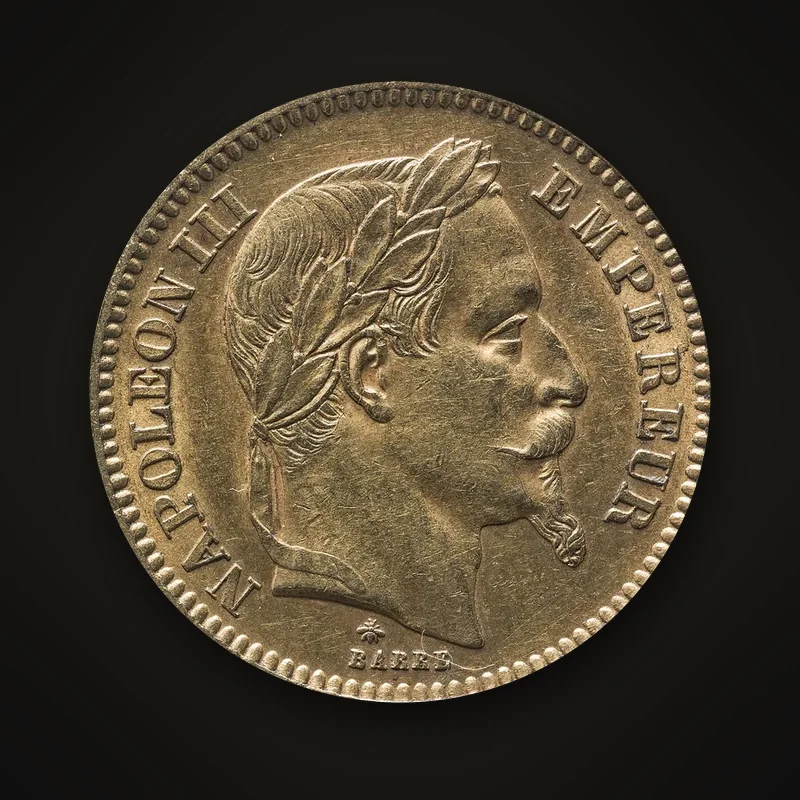
Obverse
The emperor's profile facing right, with moustache and goatee. From 1853 to 1860 the head is bare; from 1861 it wears a laurel wreath. Signed “BARRE” at the base of the neck, legend “NAPOLEON III EMPEREUR”.
Written by the Maison Or & Bijoux Cagnes-sur-Mer team · updated
| Country | France |
|---|---|
| Metal | Gold, 900‰ fine |
| Weight | 6.45 g |
| Fine gold | 5.806 g |
| Diameter | 21 mm |
| Years struck | 1853-1860 (bare head), 1861-1870 (laureate head) |
| Mints | A (Paris), BB (Bas-Rhin), D (Lyon, 1855 only) |
| Total mintage | 146,544,669 (bare head), 85,466,540 stated (laureate head) |
| References | Le Franc F.531 (bare head) and F.532 (laureate head) |
A small 21 mm gold coin with a bearded profile and “NAPOLEON III EMPEREUR” around the portrait: this is the napoléon of the Second Empire. Struck from 1853 to 1870, more than 230 million times over, it set the lasting image of the “napoléon” that still turns up in family estates. Two designs follow one another, the bare head and then the laureate head, and that is where any identification begins.
The emperor's profile facing right, with moustache and goatee. From 1853 to 1860 the head is bare; from 1861 it wears a laurel wreath. Signed “BARRE” at the base of the neck, legend “NAPOLEON III EMPEREUR”.
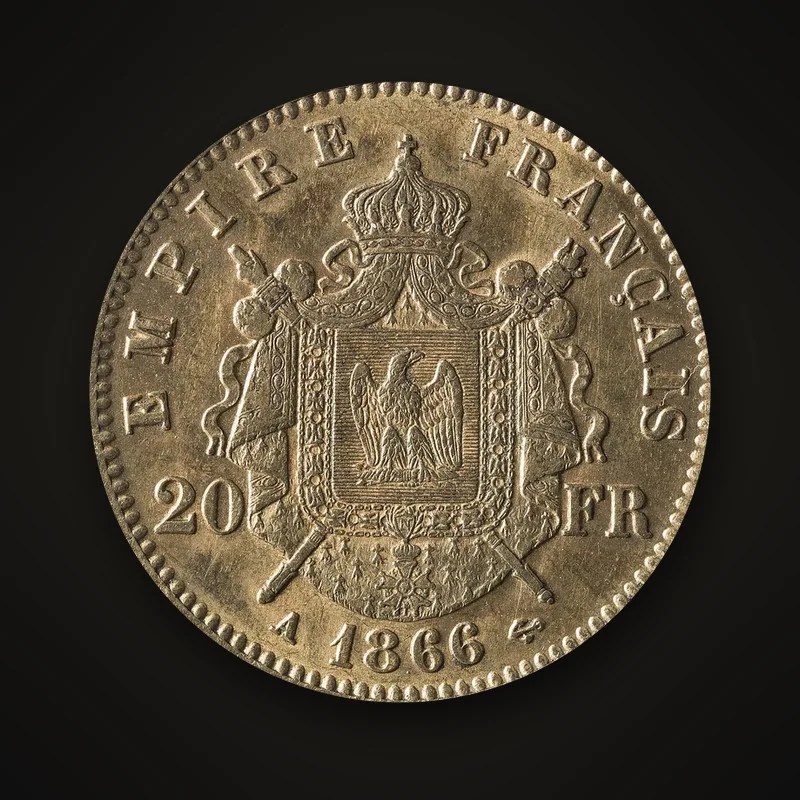
Bare head type: “20 FRANCS” and the date in the middle of a laurel wreath tied with a bow, with the mint mark below the bow; legend “EMPIRE FRANÇAIS”. Laureate head type: the imperial arms (an eagle on a thunderbolt, the collar of the Legion of Honour, a mantle topped by a crown), “20” and “FR” on either side, date and mint mark below the shield; same legend.
A selection of benchmark dates, from the largest mintages to the smallest. Paris supplied most of the coins: an A mint mark with an 1850s date is the most ordinary find of all. For the other letters, and for years with varieties, check the two small symbols beside the date as well.
| Year | Mint | Mintage | Remarks |
|---|---|---|---|
| 1853 | A | 5,729,471 | First bare head year; a few burnished flans |
| 1854 | A | 23,485,957 | Record for the type |
| 1855 | A | 16,595,397 | Privy marks dog's head and hand, or hand and anchor |
| 1855 | BB | 1,759,701 | Dog's head and bee, or bee and anchor |
| 1855 | D | 363,017 | Lyon's only year, several lion varieties; lowest mintage of the type |
| 1856 | A | 17,302,537 | Common |
| 1856 | BB | 1,125,030 | Lowest BB mintage of the bare head |
| 1857 | A | 19,193,214 | Only mint at work that year |
| 1858 | A | 16,860,982 | Common |
| 1859 | A | 20,295,429 | Common |
| 1860 | A | 10,219,917 | 6 over 5 variety |
| 1860 | BB | 5,726,718 | 6 over 5 variety |
| 1861 | A | 2,607,054 | First laureate head year |
| 1861 | BB | 1,423,199 | Lowest BB mintage of the laureate head |
| 1862 | A | 4,825,915 | “Large A” variety |
| 1864 | A | 7,058,905 | Common |
| 1865 | A | 2,951,440 | Reduced Paris mintage |
| 1866 | BB | 6,978,507 | Reeded edge variety, rare |
| 1867 | A | 2,923,024 | Reduced Paris mintage |
| 1868 | A | 9,281,061 | Record for the laureate head |
| 1869 | BB | 7,316,553 | Small and large BB; figure disputed |
| 1870 | A | 864,873 | Final year, lowest laureate head mintage |
| 1870 | BB | 1,852,567 | Final year |
Figures taken from the BDOR tables, cross-checked against Abacor; varieties after Le Franc (F.531, F.532). A year's figure covers all of its varieties together. Other sources differ slightly: 1,817,394 for 1855 BB (Numista), 2,067,740 for 1858 BB (CGB). Years left out have intermediate mintages.
Start with the emperor's hair. If it is free of foliage, you are holding a bare head, struck between 1853 and 1860. If a wreath of leaves encircles the head, it is a laureate head, from 1861 to 1870.
The reverse settles any doubt. The bare head comes with a laurel wreath surrounding “20 FRANCS” and the date. The laureate head shows a shield bearing an eagle, set on a large mantle, and the denomination is split in two: “20” on one side, “FR” on the other.
Then note the date and the letter. On the bare head, the letter sits under the bow of the wreath; on the laureate head, it is at the bottom, next to the date. With these three details you can place your coin in the table above. For the gold coins of the whole century, see French coins of the 19th century (in French).
There are only three letters: A for Paris, by far the most frequent, BB for the Empire's second mint, and D for Lyon, which struck this napoléon only in 1855. The full list of letters is in our guide to French mints (in French).
On either side of the date are two minute signs, the privy marks. One refers to the Chief Engraver, the other to the mint director. In 1855 the engraver changed: Jacques-Jean Barre's dog's head gave way to Albert-Désiré Barre's anchor. That year, therefore, a single letter comes in two combinations, and the one with the dog's head is the scarcer. As for directors, Paris signs with a hand, Lyon with a lion, and the BB mint with a bee.
On the laureate head, varieties come from the size of the letter: “large A” in 1862, small and large BB in 1864, 1867 and 1869. A ten-times loupe is all you need to read them.
These coins stayed in circulation until 1914, so most reach us in Fine or Very Fine condition (TB or TTB in French grading). To place yours, begin with the portrait.
An Extremely Fine (SUP) example keeps some original lustre in the fields, at the foot of the letters. Never rub a gold coin: a cloth leaves fine scratches that spoil it for any collector. The guide to grades and the page on cleaning coins (both in French) add to these pointers.
Platinum fakes. As early as the Second Empire, forgers struck napoléons in platinum, in both designs. The weight stays close to standard; a grey colour shows through wherever the surface is scratched or worn. The dates reported vary between sources (1858, 1860, 1865 and 1867 among them). These pieces are now collected as witnesses of their time.
Modern gold fakes. Made to imitate a sought-after coin, they often give themselves away through soft relief, poorly detailed hair, irregular edge lettering or an off-standard weight. Check for 6.45 g (a few hundredths less on a worn coin), 21 mm and a crisp edge. See the guide to spotting a fake coin (in French).
Varieties to know: 1860 with the 6 re-engraved over a 5 (A and BB), 1866 BB with a reeded edge, the burnished flans of 1853-1855, and the laureate head patterns (1861, 1862, 1868).
Not to be confused with: the 1852 20 francs reading “LOUIS NAPOLEON BONAPARTE”, struck before the Empire; the 10 francs gold coin (in French) with the same portrait, but smaller; the gold 20 lire of Sardinia and later Italy, of the same weight and size but bearing a king's effigy.
The word “napoléon” comes from the 20 francs of the First Empire, struck under the law of 7 Germinal Year XI (1803): 6.45 g of gold at 900 thousandths. Napoleon III took up this standard in 1853, a few months after the Empire was proclaimed. Gold arriving from California and Australia made huge strikings possible: in Paris, every year from 1854 to 1859 exceeded 16 million coins.
In 1865 the Latin Monetary Union brought France, Belgium, Italy and Switzerland together around this same standard. The fall of the Empire in September 1870 brought striking to an end. The Third Republic revived the Genius 20 francs, then in 1899 adopted the Rooster 20 francs, struck to the same weight and fineness until 1914 (both pages in French). For the rest of the story into the 20th century, see gold coins (in French).
The Treaty of Turin, signed on 24 March 1860, joined Nice and its county to Napoleon III's France, following the plebiscite of 15 and 16 April. Until then, the left bank of the Var reckoned in Sardinian lire, whereas Cagnes, west of the river, was already French. The change happened without a new standard: the Sardinian 20 lire coin had the same 6.45 g of gold at 900‰ and the same 21 mm diameter as the napoléon. On the Côte d'Azur, the 1860 20 francs, the last year of the bare head, is thus the gold coin of the year Nice became French.
No. That legend marks the 1852 20 francs, struck during the presidency, before the Empire. The napoléon described here reads “NAPOLEON III EMPEREUR”.
They are privy marks: one shows the Chief Engraver, the other the mint director. In 1855 they separate two varieties of the same date and the same letter.
It follows the same Latin Monetary Union standard, but it is a foreign coin: a different sovereign and a different legend. It is classified separately, even though its weight and diameter are identical.
Not necessarily. A worn coin loses a few hundredths of a gram. A larger gap, a grey colour in the scratches or a blurred edge should put you on guard. A numismatist can look into it during a free assessment (in French).