Skip to content
Monaco

Monaco franc coins, from centimes to 100 francs

Monaco · 1945-2001

Written by the Maison Or & Bijoux Cagnes-sur-Mer team · updated

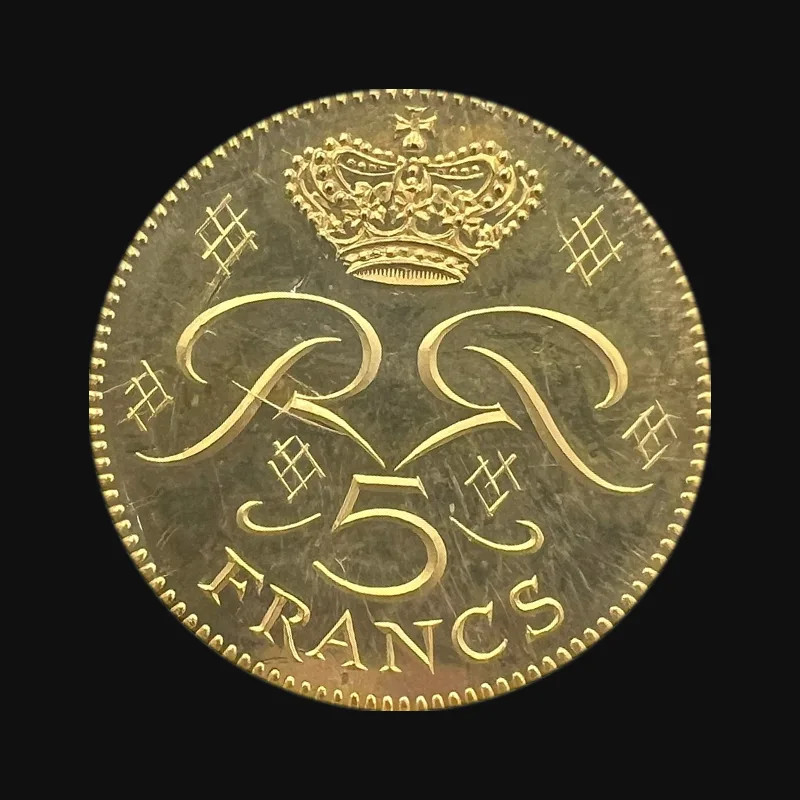
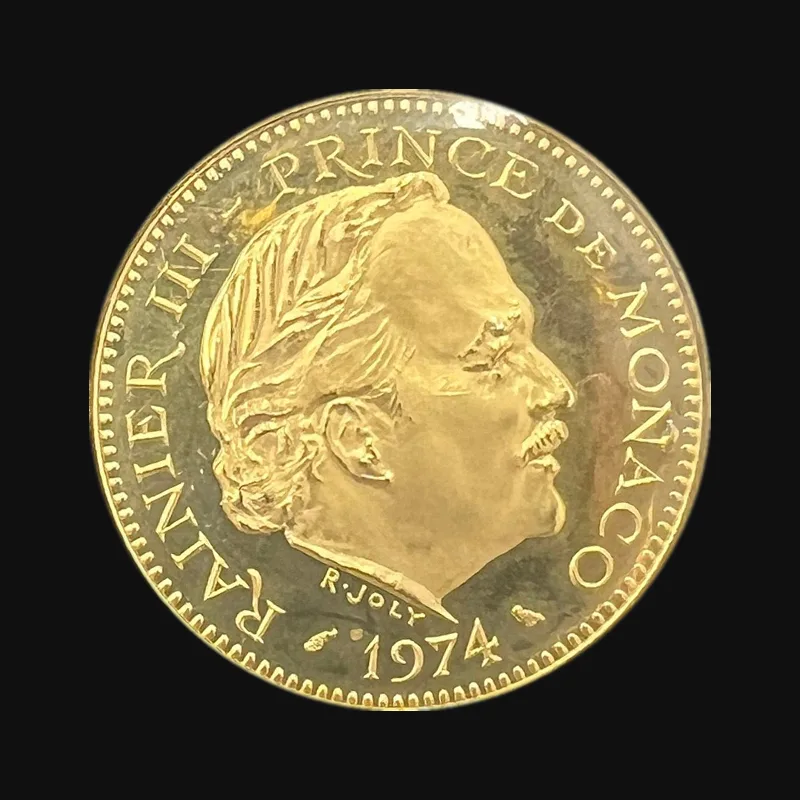
5 francs gold of Rainier III dated 1974, obverse signed R. Joly5 francs of Monaco, reverse with the crowned double R
Photos: Maison Or & Bijoux.
Specifications
CountryMonaco
Issuing stateMonaco, principality of the Grimaldis
Reigns shownLouis II (1945-1947); Rainier III (1950-2001)
ExchangeAt par with the French franc; 1 new franc for 100 old from 1960
ProductionMonnaie de Paris, no mint letter at all
AlloysCopper-nickel, nickel, aluminium or aluminium-bronze; bimetal (1989), trimetal (1992)
5 francs in silver1960 and 1966; 835‰, 12 g, 29 mm, 10.02 g fine
10 francs in silver1966; 900‰, 25 g, 37 mm, 22.5 g fine
100 francs in silver1982; 900‰, 15 g, 31 mm, 13.5 g fine
Chief engraver's marksOwl, dolphin, bee
Krause numbersKM 122, 133, 141, 146, 150, 161, 163

From 1945 to 2001, the principality had its own franc coins, with the portrait of Louis II and then Rainier III, struck in Paris and used just like the French franc. Three clues usually place a coin: the face value, the prince's name and the engraver's signature. Base metal dominates; silver, small mintages and strikes marked ESSAI are what make the difference.

Identification

Monaco franc coins, from centimes to 100 francs: how to recognise it

5 francs gold of Rainier III dated 1974, obverse signed R. Joly

Obverse

On the portrait side, the legend names the prince: LOUIS II (bust turned left, 1945 to 1947) or RAINIER III (head in profile, 1950 to 2000), followed by “PRINCE DE MONACO” and, for Rainier III, the year. A few later types drop the portrait in favour of a knight or a monogram.

5 francs of Monaco, reverse with the crowned double R

Reverse

It shows the value and the principality's crowned arms, often set on a mantle, with the motto DEO JUVANTE (“with God's help”). The bimetallic 10 francs (1989-2000) reads “PRINCIPAUTÉ DE MONACO” with the RR cypher. The word ESSAI marks a trial strike.

Edge
It changes from one value to the next: plain, reeded, striated (1966 silver 10 francs) or reeded in segments (bimetallic 10 francs).
Engraver
Maubert in 1945, Pierre Turin from 1946 to 1960, Henri Lagriffoul for the 1956 100 francs, Maurice Delannoy for the 1966 10 francs, Robert Cochet for the 1982 100 francs, Roger Bertrand Baron for the bimetallic 10 francs. Their abbreviated names can often be read under the bust.
Dates and mintages

Monaco franc coins, from centimes to 100 francs: key dates

Here the coins are sorted by face value, from centimes to 100 francs, rather than by date. Find your coin's value first, then the year: mintages below 50,000 and the word ESSAI deserve a close look.

Monaco franc coins, from centimes to 100 francs: dates and mintages
ValueDate(s)AlloyStruckComment
1 and 5 centimes1982Steel, aluminium-bronze10,000 of eachThe least-struck centimes.
10, 20 and 50 centimes1962Aluminium-bronze750,000, 750,000, 375,000Essais and piedforts (25 and 100).
1/2 franc1989Nickel10,000Late, low-mintage date.
1 franc Louis II1945Aluminium-bronze, 4 gunknownYellow version of the 1943 aluminium type.
2 francs Louis II1945Aluminium-bronze, 8 g1,082,687Engraved by Maubert.
5 francs Louis II1945Aluminium, 3.5 g1,000,00031 mm across.
5 francs Rainier III, silver1960 and 1966835‰ silver125,000 per yearCased 1 and 5 francs essais in 1960.
5 francs Rainier III1975-1979Copper-nickel10,000 to 14,500 a yearSlim mintages for a circulating coin.
5 francs, essai and piedfort1974920‰ gold1,000 and 250Essai 19.58 g; piedfort 39.6 g.
10 francs Louis II1946Copper-nickel, 7 g1,000,000Signed by Turin.
10 francs Charles III1966900‰ silver, 25 g62,500Gap with 37,500 per another source.
10 francs, 25 years of reign1974unknown25,000Anniversary of the 1949 accession.
Bimetallic 10 francs1989-2000Nickel, copper-aluminium3,000 (1989) to 238,000 (2000)First date, the least struck.
10, 20, 50 francs Rainier III1950-1951Aluminium-bronze500,000 per value and yearThe prince's first coinage.
20 francs Louis II1947Copper-nickel, 10 g1,000,000End of the Louis II types.
Trimetallic 20 francs1992Three alloys, 9 g100,000Top of the circulation series.
100 francs1950Copper-nickel, 12 g500,000Knight in armour; aluminium-bronze essai (1,700).
100 francs1956Copper-nickel, 6 g500,000Module cut to 24 mm.
100 francs1982900‰ silver, 15 g30,000Rainier III and Albert; gold piedfort (250).
10 to 100 francs, gold essais1950GoldunknownCased set of four.

Sources for the figures: Collector's Key, which follows the Krause catalogue, cross-checked with Coin Varieties, Stash of Coins, CGB and Künker. Where one total spans several years, it may be the catalogue's apportionment rather than a yearly count.

Why a Monaco franc was worth a French franc

There was no exchange rate between the two francs: parity was the rule, and each country's coins were accepted by its neighbour, according to the sources consulted. The legal framework is old. A first customs union arose from an 1865 convention; a new text replaced it in 1912, then the customs convention signed on 18 May 1963 took over on the following 1 September.

Money has its own agreements too: 1938 for the effects of devaluation, 1945 for exchange control. In 1960, with the switch to the new franc, Monaco applied the same ratio as France, one new franc for a hundred old ones.

Every coin left the Monnaie de Paris, which frequently gave them the specifications of the French coins of the time. From 1999, the Monegasque franc was merely an expression of the euro, whose coins arrived in 2002.

Three clues to date a Monegasque coin

The prince. With LOUIS II, the coin dates from 1945 to 1947: aluminium-bronze for 1 and 2 francs, aluminium for 5 francs, copper-nickel for 10 and 20 francs. With RAINIER III, prince since 1949, it dates from 1950 to 2000.

The signature. Engraved in small letters under the portrait or in the field, it often settles the question: L. MAUBERT in 1945, P. TURIN up to 1960, R. COCHET on the 1982 100 francs, R.B. BARON on the bimetallic 10 francs from 1989.

The privy mark. No mint letter on these Paris-made coins, but a small symbol either side of the date, the chief engraver's: an owl for Raymond Joly (1958-1974), a dolphin for Émile Rousseau (1974-1994), a bee for Pierre Rodier (1994-2001). Note too that the value is written in full or abbreviated.

The silver types, 1960 to 1982

Rainier III's 5 francs, struck in 1960 and again in 1966 after Pierre Turin, copies the measurements of the Semeuse 5 francs: 12 g at 835‰, 29 mm, that is 10.02 g of pure silver.

The 1966 10 francs, the work of Maurice Delannoy, is the most imposing: 37 mm and 25 g of 900‰ silver. It honours Prince Charles III, whose profile is ringed by his reign years, 1856-1889; Rainier III's arms are on the reverse.

The 1982 100 francs, designed by Robert Cochet, brings together the portraits of Rainier III and his son, Hereditary Prince Albert, on 15 g of 900‰ silver.

Essais, piedforts and gold strikes

The principality multiplied its trial strikes, identifiable by the word ESSAI, and offered them to collectors, often in cases: 1,700 aluminium-bronze essais of the 1950 100 francs, 500 sets combining the 1960 1 and 5 francs, and for the 1966 10 francs, a thousand essais on proof flans. A piedfort, for its part, is struck on a markedly thicker flan.

For 1945-2001, gold is reserved for these collector issues. A 1950 case holds the 10, 20, 50 and 100 francs as gold essais; the 1974 monogram 5 francs exists as a 920‰ gold essai (19.58 g, 1,000 pieces) and a gold piedfort (39.6 g, 250 pieces); the 1982 100 francs has its gold piedfort, also limited to 250.

Neighbouring coins not to mix up

French or Monegasque? Same fineness, weight and diameter for the Semeuse 5 francs and Rainier III's 5 francs. Same alloy and same 6.5 g mass for the Génie de la Bastille 10 francs and Monaco's bimetallic 10 francs. Read the legend.

Circulation coin or essai? Identical date and design: only the word ESSAI, an unusual thickness or a mirror field give the essai away, and its mintage is not always the lower one.

1950 or 1956? Rainier III's two old 100 francs part at a glance: 30 mm for the first, 24 mm for the second.

Coin or medal? A medal with a prince's profile carries neither a franc value nor DEO JUVANTE. As for Monaco's euro coins, struck since 2001, they belong to another series.

Judging condition, keeping the cases

An ordinary Monegasque coin, struck in hundreds of thousands, only interests a collector in very fine condition. The most exposed reliefs are the prince's hair and ear, then, on the reverse, the crown and the drapery behind the shield; the 1945 aluminium holds its details poorly.

An essai or piedfort is also judged by its presentation: case, sealed bag or original leaflet should stay with the coin. Avoid any cleaning, which leaves lasting traces, and if in doubt ask a numismatist through our coin identification page.
In Cagnes-sur-Mer

Monaco franc coins, from centimes to 100 francs in the Côte d'Azur

The name Rainier is no stranger to Cagnes-sur-Mer. Rainier I Grimaldi (c. 1267-1314), who in 1297 had taken part in seizing the Rock of Monaco with François Grimaldi, held the title of Lord of Cagnes; in 1309 he established a stronghold on the hill of Haut-de-Cagnes, today's Château Grimaldi, now a castle museum. His son Charles I succeeded him. More than six centuries later, another Rainier, Rainier III, prince from 1949 to 2005, is the name read on most Monegasque francs. Nothing ties these coins directly to the castle; they do, however, turn up in estates across the area, alongside the Rooster 20 francs.

Monaco franc coins, from centimes to 100 francs: frequently asked questions

Which Monaco circulation coin had the smallest mintage?

On the figures, the bimetallic 10 francs of 1989, first year of the type, with 3,000 pieces. Several dates at 10,000 follow: the 1989 1/2 franc and the 1982 1 and 5 centimes.

Are Monaco francs still legal tender?

Not since 2002: the euro replaced them, as in France, and they can no longer be exchanged. They are collected.

Are there Monaco francs in gold?

Between 1945 and 2001, only collector strikes: the cased 1950 essais, the essai and piedfort of the 1974 5 francs, the piedfort of the 1982 100 francs. The principality had, on the other hand, issued gold franc coins from 1879 to 1904, outside the scope of this page.

How do I recognise Prince Charles III on the 1966 10 francs?

His profile comes with his reign years, 1856-1889; the other side shows Rainier III's arms. In silver and 37 mm wide, the coin is easy to tell from the other 10 francs.

More coins
Sources