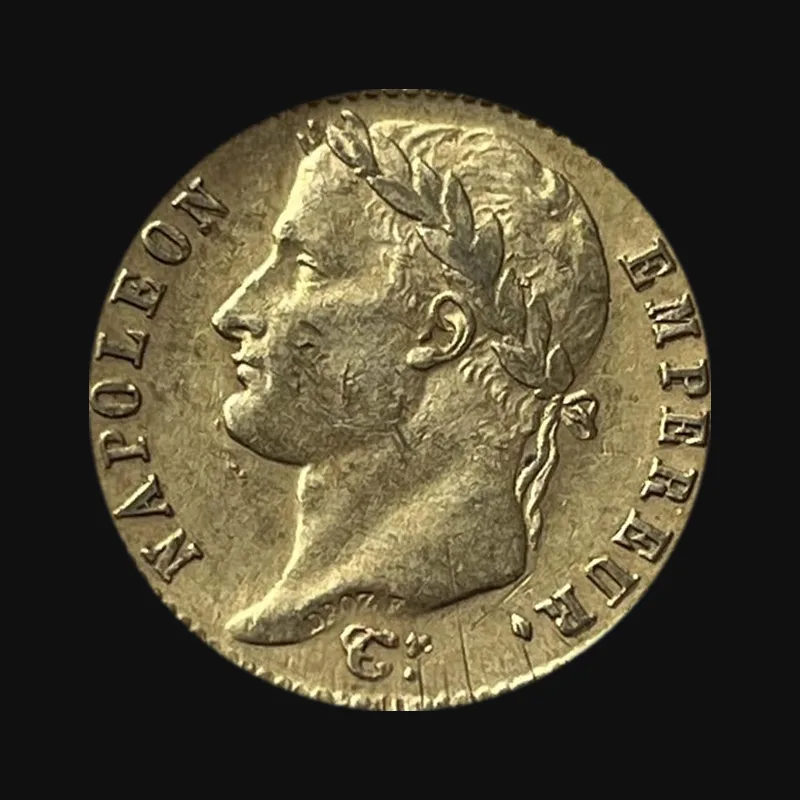
Obverse
Profile facing left. “BONAPARTE PREMIER CONSUL” on the first type, “NAPOLEON EMPEREUR” on all the following ones from Year 12. Bare-headed portrait until 1807; laurel from that same year.
Written by the Maison Or & Bijoux Cagnes-sur-Mer team · updated
| Country | France |
|---|---|
| Metal | Gold, 900‰ fine |
| Weight | 6.45 g |
| Fine gold | 5.806 g |
| Diameter | 21 mm |
| Years struck | 1803 (Year XI) to 1815 |
| Types | Seven, catalogued F.510 to F.516A; the laureate head with Empire reverse is by far the most struck |
| Mints | 13 marks: A, H, I, K, L, M, Q, T, W in France; U Turin, CL Genoa, crowned R Rome, mast Utrecht |
| Mintage of the Empire type | Over 13.8 million (1809-1814), plus 463,682 in 1815 |
| Engraver | P.-J. Tiolier (first two types), J.-P. Droz (the other five) |
| Edge | “DIEU PROTEGE LA FRANCE” |
| References | Gadoury 1020 (Consul) and 1025 (Empire); Le Franc F.510 to F.516A; Krause 651, 674, 695 |
Before the Genius, the Rooster or Napoleon III, there was this 20 francs: the very first gold coin of the Germinal system, decided in 1803 under the Consulate. It shows Bonaparte, then Napoleon crowned with laurel, and its reverse legend moves from the Republic to the Empire. Struck until 1815 in a dozen mints, from La Rochelle to Rome, it was produced in nearly 20 million pieces.
Profile facing left. “BONAPARTE PREMIER CONSUL” on the first type, “NAPOLEON EMPEREUR” on all the following ones from Year 12. Bare-headed portrait until 1807; laurel from that same year.
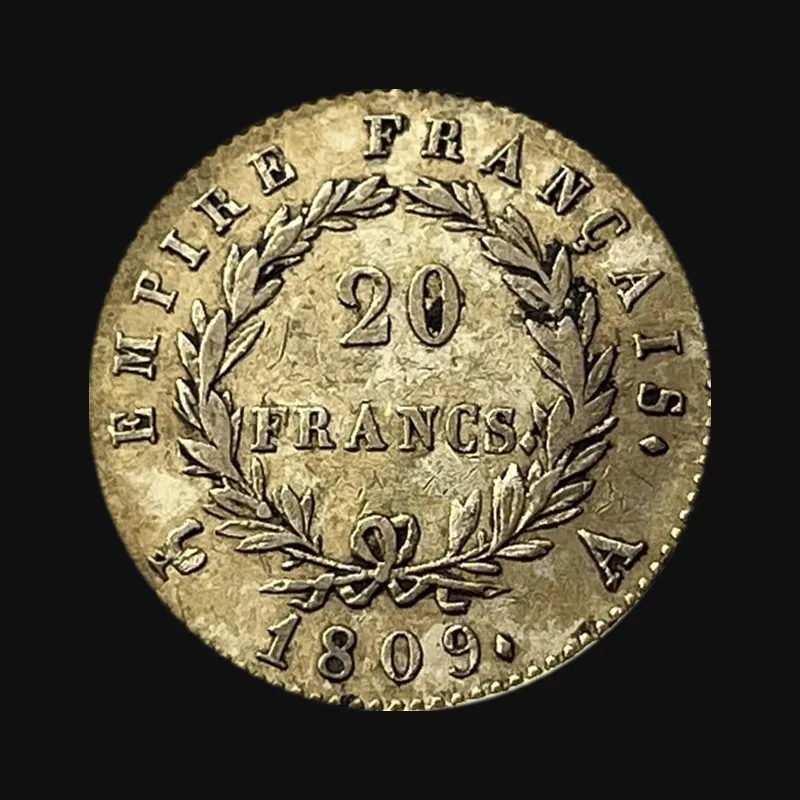
A wreath of leaves frames “20 FRANCS” and the date; the mint is shown by a letter or a symbol under the wreath. Legend “REPUBLIQUE FRANÇAISE” up to and including 1808, then “EMPIRE FRANÇAIS”. Revolutionary dates, from AN XI to AN 14, until 1805; Gregorian years from 1806.
This selection sets Paris against the low-output mints, especially those of the Italian peninsula: Turin, Genoa and Rome. First locate the mark under the wreath: a single letter, the double letter CL, an R topped by a crown or a small mast. Only then read the year. Mintages of a few hundred or a few thousand pieces call for a careful check of the letter.
| Year | Mint | Mintage | Remarks |
|---|---|---|---|
| Year XI | A | 58,262 | Creation date, the Consul's most sought-after |
| Year 12 | A | 988,244 | Last year of the First Consul |
| Year 12 | A | 428,143 | Tiolier's Napoleon Emperor |
| Year 13 | T | 918 | Nantes |
| Year 14 | A | 148,308 | Bare head, end of revolutionary dates |
| Year 14 | U | 1,755 | Turin, first Italian 20 francs |
| 1806 | A | 963,896 | Bare-head type of 1806 |
| 1806 | U | 17,278 | Turin |
| 1807 | A | 581,934 | Transitional type |
| 1808 | M | 22,273 | Toulouse, the so-called “horn” variety |
| 1809 | H | 501 | La Rochelle |
| 1810 | A | 1,936,194 | Two sizes of rooster |
| 1811 | A | 3,705,489 | Record year in Paris |
| 1812 | Crowned R | 13,693 | Rome |
| 1813 | CL | 4,380 | Genoa |
| 1813 | Mast | 90,183 | Utrecht, “1813” or “18 13” |
| 1814 | CL | 887 | Genoa, final year |
| 1815 | A | 435,981 | Hundred Days, 5 over 4 variety |
| 1815 | W | 9,369 | Hundred Days, Lille |
Numbers drawn from the BDOR tables for each type; the existence of each year and mint pair checked on the Le Franc list (F.510 to F.516A), and totals set against Wikipedia. Coinvarieties departs slightly for a few dates, such as 1806 A (962,929) or 1811 A (3,702,681). The Empire-reverse type counts 42 combinations: the table keeps only part of them.
The law of 7 Germinal Year XI, passed on 28 March 1803, created the silver franc of 5 g; for gold, it provided for 20 and 40 francs pieces at 900 thousandths. 155 pieces of 20 francs are cut from one kilogram: the weight of 6.45 g follows, and it would not move again until 1914, under every regime.
This 20 francs replaced the louis d'or, whose name long remained in conversation. The nickname “napoléon” is said to have become common only under the Second Empire, Wikipedia notes. To place the coin among its successors, see the page on 19th-century French coins (in French).
On the obverse, there are only two legends. “BONAPARTE PREMIER CONSUL” matches the strikings of Year XI and Year 12, engraved by Tiolier. “NAPOLEON EMPEREUR” covers all the rest, starting with the Year 12 type, known as the intermediate bust, which nevertheless keeps a republican reverse.
Droz's portrait then does the sorting: bare head in Year 13, Year 14 and 1806; transitional “big head” in 1807; laureate head from 1807. On the reverse, “REPUBLIQUE FRANÇAISE” survives until 1808. The decree of 22 October 1808 imposes “EMPIRE FRANÇAIS” for coins of 1809 and the following years, including those of the Hundred Days, in 1815.
Paris (A) struck the overwhelming majority of the coins. In the provinces, Bordeaux (K), La Rochelle (H), Limoges (I), Bayonne (L), Toulouse (M), Perpignan (Q), Nantes (T) and Lille (W) often produced only small runs.
As the Empire grew, gold was also struck beyond today's borders. Turin, marked U, began in Year 14. Rome, with its crowned R, Genoa, under the mark CL, and Utrecht, recognisable by a mast, followed between 1812 and 1814, with mintages of a few thousand pieces in Rome and Genoa. The guide to mints (in French) presents these marks.
Several die varieties are known: large or small rooster (Paris, 1810), “horn” flaw under the laurel (Toulouse, 1808), wide or narrow dates in Rome, Turin and Lille, a spaced “18 13” in Utrecht, 5 re-engraved over 4 (Paris, 1815). The Emperor type of Year 12 is still found in medal strike, or without the dot that usually follows “FRANÇAISE”.
The 40 francs gold coin repeats Napoleon's portraits, but it is twice as heavy (12.90 g) and wider (26 mm). The Napoleon III 20 francs, from 1853 to 1870, is recognised by the “III” after the name.
Two confusions demand more attention. In 1814 and 1815, Louis XVIII struck 20 francs with a draped bust: a date of 1815 is therefore not enough, you must read the name. The Kingdom of Italy, for its part, issued 20 lire of the same size in the name of “NAPOLEONE”, with an Italian legend. As for the louis d'or, often named in families for any 20 francs, it is a coin of the Ancien Régime.
These coins were often worn as jewellery. On the edge, a filed area, a trace of solder or crushed letters, often above the head, point to a removed loop. Cleaning with a cloth or a paste leaves fine scratches and dulls the field; it is better to do nothing. See the guide on not cleaning a coin (in French).
For wear, look first at the hair near the ear, then the temple and the top of the cheek, then, on laureate heads, the veins of the leaves. On the reverse, the wreath around the value is the best witness: distinct leaves and a crisp bow indicate a lightly circulated coin. The guide to grades of condition (in French) details the scale.
Fakes in gold of the right fineness are not rare. Weigh (6.45 g), measure (21 mm), examine the edge letters. Hair without detail or a grainy background should raise doubts. A rare mark, such as CL or a crowned R, or a Year XI, may have been added by retouching: a numismatist checks it under a loupe. See the guide to spotting a counterfeit (in French).
Throughout the period when this 20 francs was struck, the Var had ceased to be a border. Cagnes, a frontier post since 1388 facing the lands of Savoy, saw the boundary move back in 1793, when the County of Nice became the department of Alpes-Maritimes; the Grasse area, for its part, remained attached to the department of Var. The Treaty of Paris of 30 May 1814 gave France back its borders of 1792: the river became a state boundary again, until the union of 1860. The imperial coins that turn up today in estates of the area thus date from a parenthesis of some twenty years during which the river no longer separated two countries. For the gold of 1860, see the Napoleon III 20 francs gold coin, or ask for a free coin valuation.
No, it is a French coin struck in a mint of the Empire: U for Turin, CL for Genoa. The crowned R stands for Rome and the mast for Utrecht. These marks often have low mintages.
6.45 g for 21 mm, of which 5.806 g is fine gold. A heavily worn coin can lose a few hundredths of a gram; a clearer gap calls for a check.
Between Year 12 and 1808, the reverse legend remains “REPUBLIQUE FRANÇAISE”. It was a decree of 22 October 1808 that had “EMPIRE FRANÇAIS” engraved from 1809.
No. If the legend names Louis XVIII, it is a Restoration 20 francs. Only the 1815 coins marked “NAPOLEON EMPEREUR” belong to the Hundred Days.