Skip to content
France

Louis d'or: four reigns, some twenty types

France · 1640-1792 · Gold

Written by the Maison Or & Bijoux Cagnes-sur-Mer team · updated

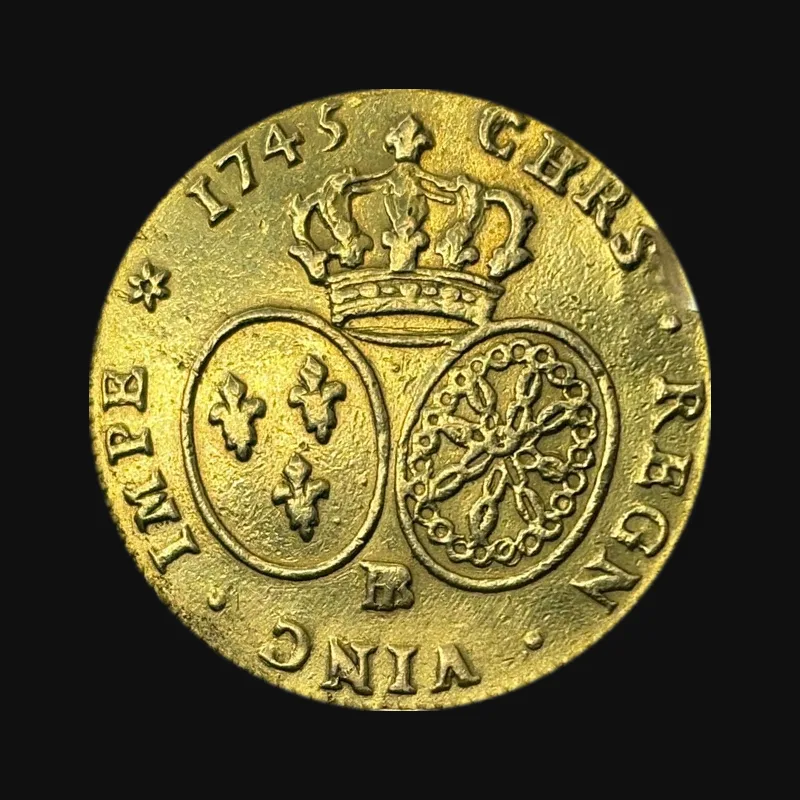
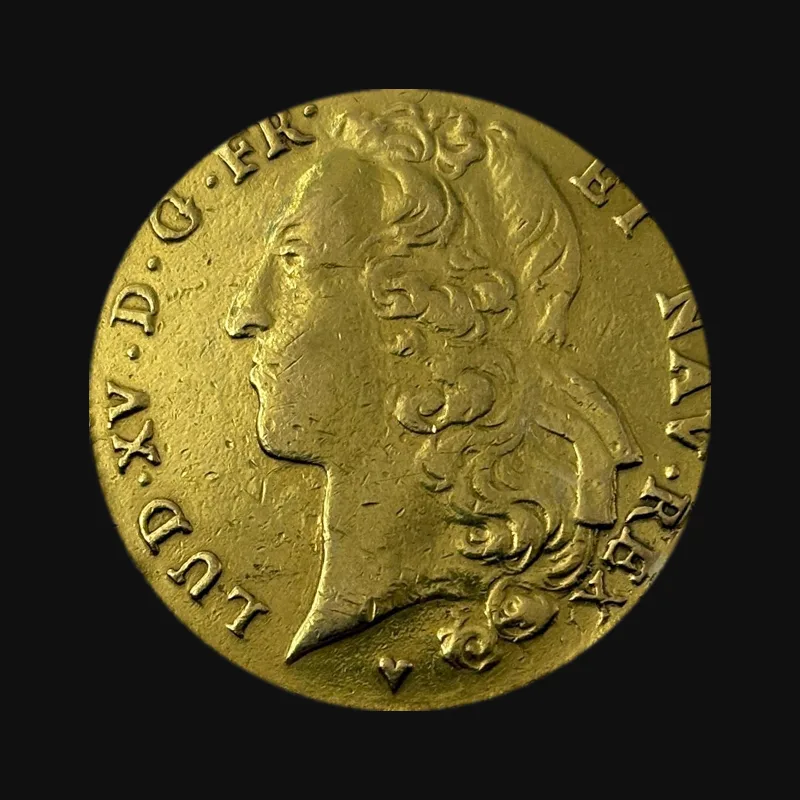
Louis d’or of Louis XV, obverse with the king’s bustLouis d’or dated 1745, reverse with the oval shields of France and Navarre under the crown
Photos: Maison Or & Bijoux.
Specifications
CountryFrance
AlloyGold 917‰, i.e. 22 carats
Legal weight of the louis6.75 g from 1640 to 1709; 8.158 g in 1709-1715 and again in 1726-1785; 7.649 g between 1785 and 1792; several weights between 1716 and 1725
DiameterBetween 22 and 26 mm
StruckFrom 1640 to 1792; constitutional louis until 1793
Multiples and fractionsHalf louis, double louis; 4, 8 and 10 louis struck in 1640
Mint lettersA Paris, D Lyon, K Bordeaux, T Nantes, W Lille, & Aix, BB Strasbourg, among some twenty others

Created under Louis XIII in 1640, the louis d'or served four kings until 1792. Each reign brought a new portrait and reverse, and monetary reforms made its weight swing from about 6.5 g to a little over 12 g. Sorting a coin by reign is often the quickest way to identify it.

Identification

Louis d'or: four reigns, some twenty types: how to recognise it

Louis d’or of Louis XV, obverse with the king’s bust

Obverse

The royal portrait, surrounded by the Latin legend of the king's titles. A simple guide: profile to the right for Louis XIII and Louis XIV, to the left for their two successors. For Louis XIV, the legend “LVD. XIIII. D. G. FR. ET NAV. REX” reads as Louis XIV, by God's grace King of France and Navarre. Date and mint letter are frequently engraved below the bust.

Louis d’or dated 1745, reverse with the oval shields of France and Navarre under the crown

Reverse

A cross of eight crowned Ls under Louis XIII and for several Louis XIV types (the sun among them), then four Ls or four lilies, royal insignia, and lastly the shields of France and Navarre: oval on the louis aux lunettes, square from 1785 to 1792. The motto “CHRS. REGN. VINC. IMP.” abbreviates “Christus regnat, vincit, imperat” and appears on nearly every type.

Edge
Milled, except for the Louis XIII louis, whose edge is plain according to Numista.
Engraver
Under Louis XIII and in the youth of Louis XIV, Jean Warin; for the sun and the early reign of Louis XV, Norbert Roettiers; for the headband, Joseph-Charles Roettiers; under Louis XVI, Pierre-Benjamin Duvivier, whose signature DUVIV is read at the foot of the bust.
Dates and mintages

Louis d'or: four reigns, some twenty types: key dates

How to read the table: one reign, then its types in order. The legal weight comes from the Numista catalogue; weigh the coin to a hundredth of a gram and compare your reading with this column. The years in which a given type was struck can differ from one mint to another.

Louis d'or: four reigns, some twenty types: dates and mintages
ReignTypePeriodLegal weightNote
Louis XIIICross of eight Ls (first louis)1640-16436.752 gThe very first louis
Louis XIVShort lock (mèche courte)1643-16566.751 gAfter 1645, struck at Lyon only
Louis XIVLong lock (mèche longue)1646-16606.751 gChild portrait with a long curl
Louis XIVBare head, large head1668-16836.751 gAdult portrait, large head
Louis XIVShield type (à l'écu)1690-16936.751 gTime of the réformations
Louis XIVFour Ls (quatre L)1693-17006.751 gCross of lilies and four Ls
Louis XIVEight Ls with insignia1700-17036.751 gInsignia between the Ls
Louis XIVInsignia (aux insignes)1704-17096.751 gTwo hairstyles exist
Louis XIVSun (au soleil)1709-17158.158 gFirst louis at 8.158 g
Louis XVInsignia17168.158 gTwo types in 1716
Louis XVNoailles louis1716-171812.235 gHeaviest of the series
Louis XVCross of the Holy Spirit1718-17199.79 gJohn Law's system
Louis XVTwo Ls (deux L)1720-17239.79 gInterlaced Ls
Louis XVMirliton1723-17256.525 gTwo sizes of palms
Louis XVSpectacles (aux lunettes)1726-17408.158 gOval shields side by side
Louis XVHeadband (au bandeau)1740-17748.158 gLongest-lived type of the reign
Louis XVOld head (vieille tête)1771-17748.158 gPortrait of the aged king
Louis XVIPalms (aux palmes)17748.158 gOne year only
Louis XVISpectacles (aux lunettes)1774-17858.158 gEmbroidered coat
Louis XVIBare head (tête nue)1785-17927.649 g1785 reform, square shields
Louis XVIConstitutional louis1792-17937.649 gWorth 24 livres

Taken from Numista; references Gadoury, Duplessy and Clairand. The many successive busts of Louis XIV between 1660 and 1690 are not detailed, nor are the louis struck for Béarn.

Louis XIII and Louis XIV: the 6.75 g louis

The first louis came off the presses in 1640, under Louis XIII. Engraved by Jean Warin and struck on a screw press, it weighed a little over 6.75 g of 22-carat gold; its neatly round blank makes the slightest clipping visible.

Louis XIV kept that weight for more than sixty years while frequently changing the design: short lock, long lock, bare head, then, from 1690, the shield, four Ls and insignia types. Only in 1709 did the recoinage of the sun louis raise it to 8.158 g.

The 1690s were also the years of the réformations: the mints restruck the louis in circulation rather than melting them. Letters or outlines of the old type sometimes remain visible. It is a feature of the period recorded by the catalogues, not the sign of a copy.

Louis XV: shifting weights, then the 1726 edict

The new reign opened in 1716 with two insignia types, then the Noailles louis, which at 12.235 g outweighs every other circulating louis. Next came the cross of the Holy Spirit and the two Ls, at about 9.79 g, in the days of John Law's system, and the mirliton of 1723, cut to 6.525 g.

The edict of January 1726 brought the louis back to 8.158 g. That weight did not move again under Louis XV: spectacles louis from 1726, headband from 1740, old head from 1771 to 1774. Mirliton coins are found with short or with large palms, a variety collectors follow.

Louis XVI: two types and a final reform

The reign began with a palms louis struck in 1774 alone, then a spectacles louis in which the king wears an embroidered coat, still at 8.158 g.

In 1785 a reform lowered the weight to 7.649 g. The new louis shows the king's bare head, signed DUVIV, and two square shields side by side on the reverse. This type was struck until 1792, followed by the constitutional louis of 24 livres, issued until 1793.

Not to be confused: the 20 francs gold coin introduced in 1803, still called a “louis” in many families, is a napoléon, like the Napoleon III 20 francs gold coin.

Half, double, multiples: let the scale decide

The same design can come in three sizes. The half louis carries half the weight of the louis of its day, that is 3.376 g before 1709 and around 4.08 g for the headband, spectacles and sun types, with a diameter close to 20 mm.

The double louis does not go with every type. Numista lists it for both Louis XVI types, three Louis XV types (mirliton, headband, old head), four Louis XIV types (shield, four Ls, insignia, sun) and for Louis XIII. The double with square shields reaches about 28 mm.

As for the 4, 8 and 10 louis of 1640, struck in Paris, they are prestige pieces that did not circulate in everyday use.

Jewellery and copies remain the two traps: solder or a filled hole reduces the coin's appeal, and imitations in low-grade gold or gilt metal give themselves away by weight, diameter and soft lettering.

Wear points to watch

On the face side, the first points to wear are the hair near the ear, the headband or laurel wreath, then the cheekbone. For Louis XV and Louis XVI, the locks vanish before anything else.

On the reverse, the crowns over the shields or the Ls are telling: pearls well separated on a fresh coin, an almost smooth band on a tired one. A flattened or filed milled edge suggests clipping or a former mount.

Cleaning shows up as a haze of scratches in the field and lowers the grade. Bring the coin as it is for a coin valuation.
In Cagnes-sur-Mer

Louis d'or: four reigns, some twenty types in the Côte d'Azur

On the right bank of the Var, which then separated Provence from the lands of Savoy, Cagnes belonged to the Grimaldi family. Under Louis XIII and Richelieu, Jean-Henri Grimaldi turned the fortress of Haut-de-Cagnes into a lordly residence: the main works, which the château's own histories place between 1620 and 1646, span the years in which the louis d'or was born. Early in the next century, a counterfeiting affair touched the family. According to the same accounts, Honoré III Grimaldi, Marquis of Cagnes, produced false money around 1707-1709, until Joseph de Montesquiou, Count d'Artagnan, uncovered the equipment during a search. The sources consulted do not say which coins were imitated. The château, now a municipal museum, is still open to visitors.

Louis d'or: four reigns, some twenty types: frequently asked questions

The profile on my louis faces left: which king is it?

Louis XV or Louis XVI. The numeral after LVD in the legend (XV or XVI) decides, and the reverse then narrows down the period.

What is a “mirliton” louis?

A light louis of Louis XV (6.525 g) struck from 1723 to 1725. Collectors tell two varieties apart: palms that are short, and the large palms used in 1724-1725.

Do the spectacles louis of Louis XV and Louis XVI look alike?

They share the nickname and the weight, 8.158 g, but the portrait changes: under Louis XVI, the king appears as a bust wearing an embroidered coat. The first dates from 1726 to 1740, the second from 1774 to 1785.

Why can two overlapping designs be seen on some louis?

Because in the 1690s the mints restruck old louis with a new type. These réformations sometimes leave traces of the first striking.