Why so many $20 coins in France
Created in 1849 in the wake of the California gold rush, the double eagle is worth two $10 eagles. James Longacre engraved its first model, struck in quantity from 1850, in Philadelphia but also in San Francisco, New Orleans and Carson City, a Nevada mining town. From the 1880s, these coins were used to settle trade with Europe: they crossed the ocean in bags of 250 and piled up in bank reserves.
In 1933, Franklin Roosevelt first banned gold from leaving the country, then obliged Americans to give back their coins. The 1933 date never left the Mint and most recent coins went to the furnace. Those on this side of the Atlantic were spared; from the 1940s, they left the vaults and passed between collectors and families.
The Saint-Gaudens design
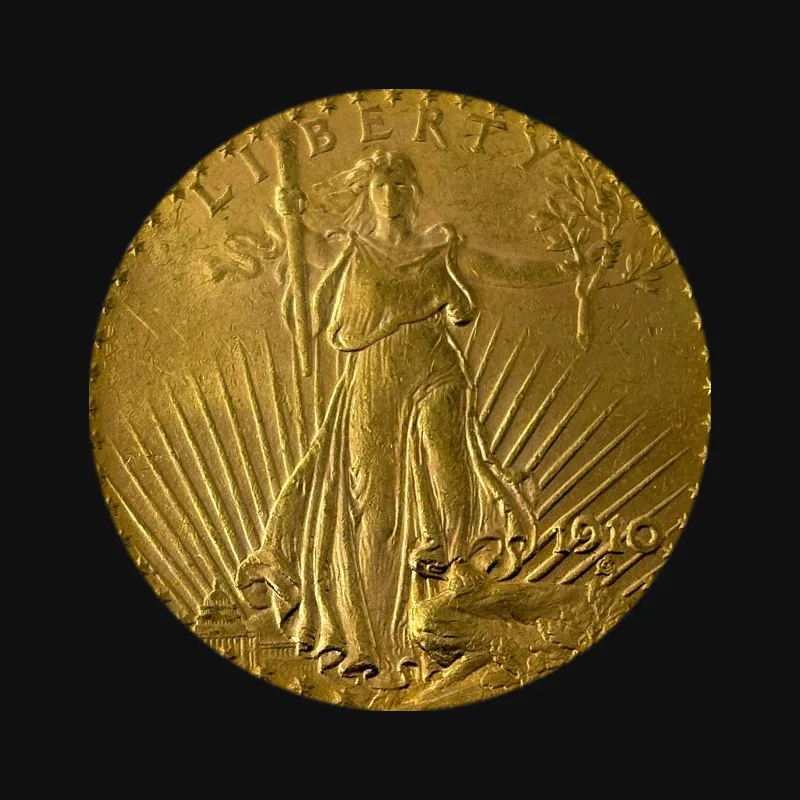
Theodore Roosevelt found his country's coins lacking in beauty. He gave the $20 to the sculptor Augustus Saint-Gaudens, who imagined a walking Liberty whose relief recalls statuary. The artist died in August 1907 before the work was done. Charles Barber, the chief engraver, then flattened the relief so that a single press stroke would do.
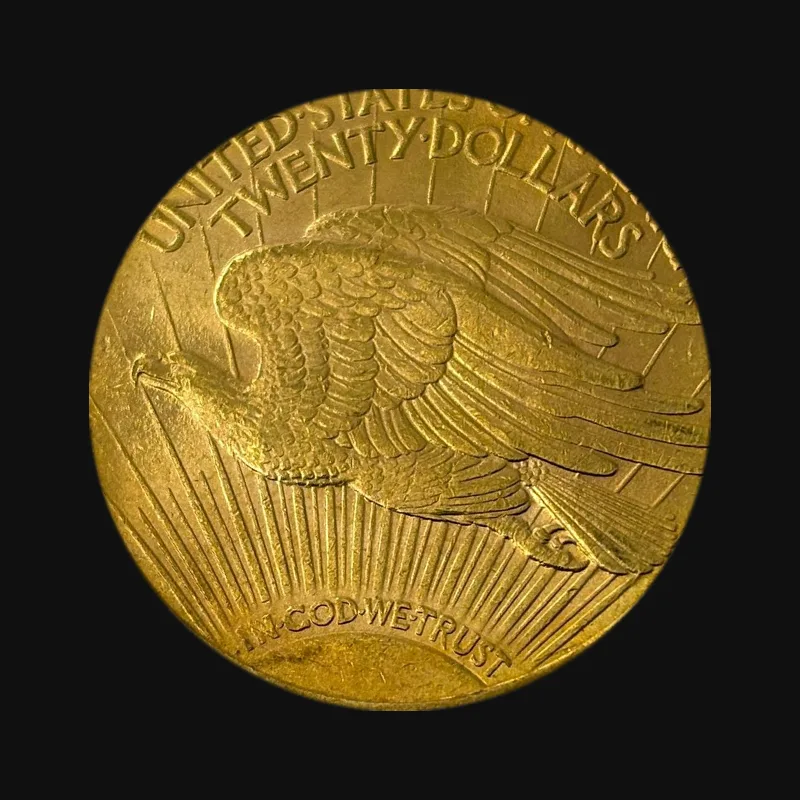
This story can be read on the coin. The first coins, in high relief and dated MCMVII, required several strikes. The lowered relief, dated in Arabic numerals, took over. As Roosevelt had set the motto aside, the 1907 coins and part of 1908 lack “IN GOD WE TRUST”; Congress brought it back in 1908. The move from 46 to 48 stars, in 1912, marks the admission of Arizona and New Mexico.
The three Liberty types
The first model also evolved. Type I, from 1850 to 1866, has no motto and shortens the value to “TWENTY D.”. Type II, from 1866 to 1876, places “IN GOD WE TRUST” inside the oval of stars. Type III, from 1877 to 1907, writes “TWENTY DOLLARS”. A curiosity: in 1861, San Francisco struck a small number of coins with a reverse altered by Anthony Paquet, dropped almost at once.
When a coin looks like a double eagle
The $10. Same family, half the weight, about 27 mm, with “TEN D.” or “TEN DOLLARS” on the reverse and, after 1907, a Liberty in a feathered headdress. See the $10 gold page.
Recent American coins. The Saint-Gaudens dated MMIX, a 2009 striking in pure gold with an ultra high relief, is a collector issue. The American Gold Eagle, since 1986, reuses the walking Liberty with, on the reverse, a family of eagles and a value of 50 dollars for the ounce.
Gilt copies. Souvenir objects reproducing one model or the other, sometimes bearing the word “COPY”: their weight stays well short of 33.44 g.
Gold fakes: what to look at
Fake double eagles abound, and many are gold. A large share dates from the 1960s and 1970s, when demand for gold in the Middle East encouraged clandestine strikings, sometimes at the regulation weight. Weighing therefore proves nothing on its own.
- The relief: on a copy, it is often soft, as if swollen.
- The initials and date: thick strokes, blurred outlines.
- The field: small bumps, small holes, excessive shine.
- The colour: gold of a shade unlike period coins.
- The mint letter: on rare dates, it may have been added or scraped off.
The guide spotting a fake coin (in French) sets out the method; for an uncommon date, a numismatist will decide.
Wear and bag marks
Liberty: watch first the hair framing the eye and ear, next the diadem, where “LIBERTY” fades from the top. On the reverse, the eagle's head and neck and the top of its wings lose their feathers first.
Saint-Gaudens: Liberty's breast and left knee wear first, then the face and the torch; the tiny Capitol fades fast. On the eagle side, it is the wing and the body that need examining.
Having stayed for decades in bags in banks, many coins circulated little but knocked against one another: scuffs, small hits, a marked edge. These flaws weigh heavily in a collector's assessment. Rub nothing and refer to coin grades (in French).