The 1795 Hercules, ancestor of the 1960s coins
Augustin Dupré's design shows Hercules uniting Liberty and Equality. It appears on the very first 5 francs, in Year 4, returns in 1848 and then serves from 1870 to 1878 for the Third Republic. Nearly a century later, the Paris Mint revived it for the 10 francs Hercule of 1965 and the 50 francs Hercule of 1974, the first with exactly the écu's weight and diameter, the second heavier (30 g).
To date a 19th-century Hercules, the legend is enough: “UNION ET FORCE” points to the Directory, the republican motto to the other two periods. The edge confirms it: “GARANTIE NATIONALE” on one side of that divide, “DIEU PROTEGE LA FRANCE” on the other.
Portraits and Ceres: the century's other écus
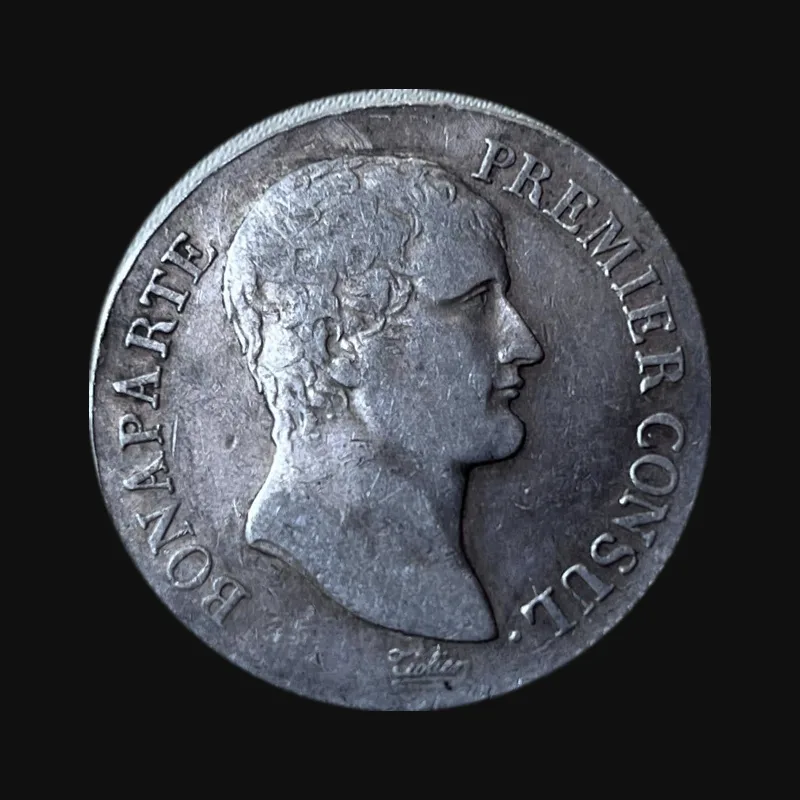
Between the two Hercules periods, successive governments put their own effigy: Bonaparte then Napoleon, Louis XVIII and Charles X with their arms, Louis-Philippe and his three portraits, Louis-Napoleon and Napoleon III. The Second Republic added the head of Ceres, which the Government of National Defence took up again in 1870, without legend, in Bordeaux.
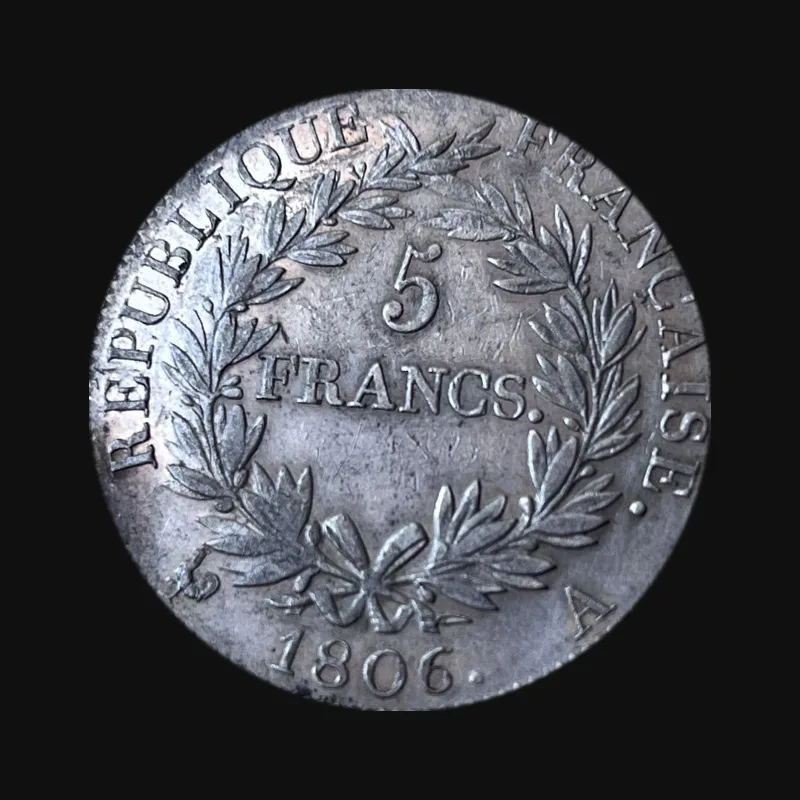
All these coins share one standard, set by the law of 7 Germinal Year XI (1803): 5 g of 900‰ silver per franc, hence 25 g for an écu. The franc itself dated from 15 August 1795 (law of 28 Thermidor Year III), which already provided for a 5 francs coin. The context is summed up in the 19th-century overview.
Bee, trident and other signs under the glass
The two privy marks beside the date stand for the mint director and the engraver. In Paris in 1871, the bee and the trident share the same year: the trident marks the Commune écus, struck under Zéphirin Camélinat's direction. On Directory écus, overdates (Year 6/5, Year 8/5) recall that dies were used for several years.
As for counterfeits, there are period ones, cast in tin or base metal, and recent ones. Scales, calipers and a look at the edge rule out most: 25 g, 37 mm, regular lettering. A gritty surface, soft relief or a dull sound should raise doubts. Full method: recognising a counterfeit.
Spotting wear and damage
After decades in circulation, most écus grade Fine or Very Fine; unworn ones are rare, the more so the older they are.
- Hercules: torso, knee, hand on Liberty's shoulder, folds of the robes.
- Portraits: hair above the ear, cheek, laurel; Louis-Philippe's curly nape.
- Reverse: leaves of the wreath, detail of the arms and the crown above them.
Edge knocks and marks in the field are common on such a heavy coin. Do not use any product: a stripped, uniformly white écu loses most of its appeal. To go further: grades explained and what to know before cleaning.
Why striking stopped in 1878
1865 saw the birth of the Latin Monetary Union, bringing together Italy, France, Switzerland and Belgium: their 5 francs or 5 lire écus followed a common standard and passed from one country to another. When silver depreciated against gold, these countries decided to suspend the striking of écus; 1878 is the last French date. Coins already issued stayed in use until the First World War. More silver coins on the silver coins page.