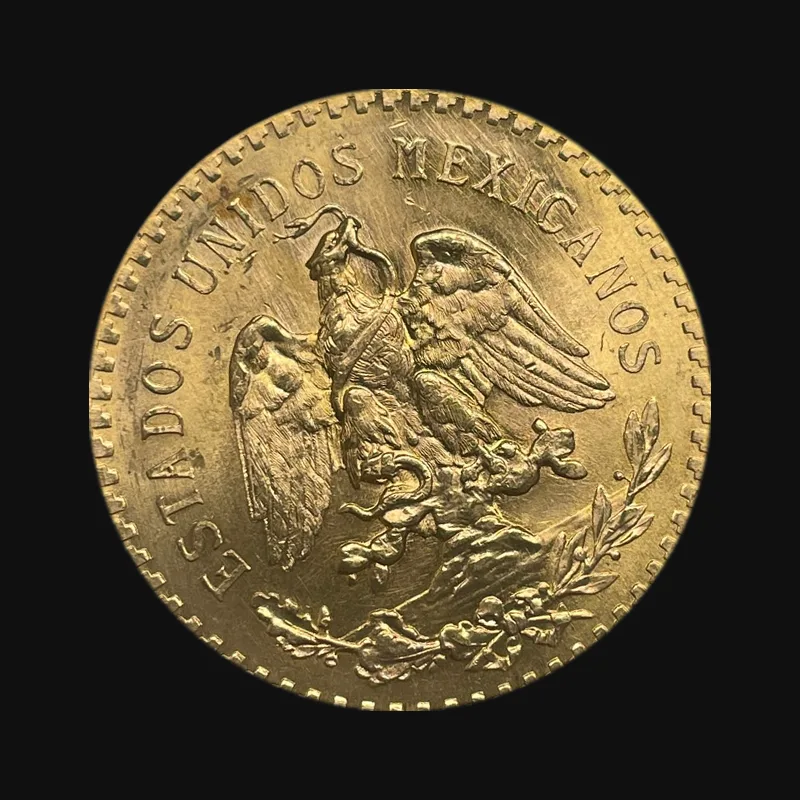
Obverse
Arms of Mexico: the eagle, perched on a prickly pear cactus, holds a snake in its beak; oak and laurel form a half-circle beneath it. Around runs the legend “ESTADOS UNIDOS MEXICANOS”.
Written by the Maison Or & Bijoux Cagnes-sur-Mer team · updated
| Country | Mexico |
|---|---|
| Alloy | 900‰ gold, 100‰ copper |
| Weight | 41.666 g |
| Fine gold content | 37.5 g (1.2057 troy oz) |
| Diameter | 37 mm |
| Thickness | close to 2.8 mm |
| Strikings | 1921 to 1931, 1943 to 1947, then restrikes dated 1947 |
| Mint | Mexico City |
A hundred years after 1821, Mexico struck a 50 pesos gold coin that the whole world now calls the “Centenario”. It weighs 41.666 g for 37.5 g of pure gold, more than modern ounces. Its reverse shows the Angel of Independence before two volcanoes, its obverse the Mexican eagle. Nearly every piece around today comes from the restrikes bearing the date 1947; collectors are mainly interested in the other dates.
Arms of Mexico: the eagle, perched on a prickly pear cactus, holds a snake in its beak; oak and laurel form a half-circle beneath it. Around runs the legend “ESTADOS UNIDOS MEXICANOS”.
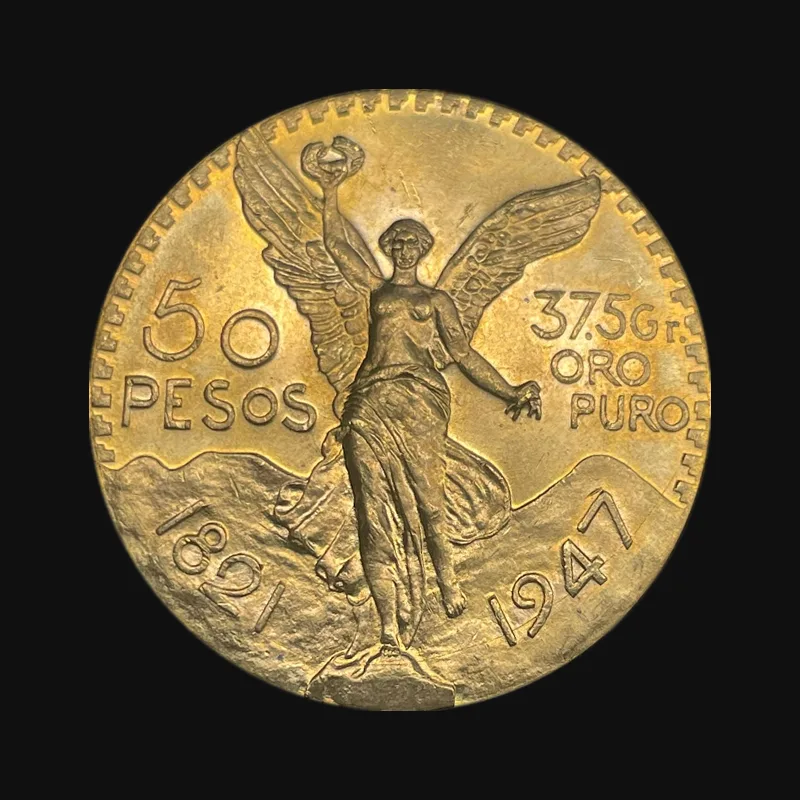
In the centre, the winged Victory from Mexico City's Independence monument, laurel wreath raised and broken chains in hand. Popocatépetl and Iztaccíhuatl fill the background. Inscriptions: “50 PESOS” for the value, “37.5 Gr. ORO PURO” for the metal. The bottom of the coin pairs two years: 1821 on the left, the year of striking on the right.
Here are the mintages year by year. Three dates stand out: 1931, the lowest of the first period, 1921, the centenary year, and 1943, struck without the value “50 PESOS”. A piece marked 1947 is very likely a later restrike.
| Year | Type | Mintage | Remarks |
|---|---|---|---|
| 1921 | Centenario | 180,000 | Anniversary date, popular with collectors. |
| 1922 | Centenario | 463,000 | |
| 1923 | Centenario | 432,000 | |
| 1924 | Centenario | 439,000 | |
| 1925 | Centenario | 716,000 | Largest figure before 1931. |
| 1926 | Centenario | 600,000 | |
| 1927 | Centenario | 606,000 | |
| 1928 | Centenario | 538,000 | |
| 1929 | Centenario | 458,000 | |
| 1930 | Centenario | 372,000 | |
| 1931 | Centenario | 137,000 | Lowest mintage up to the interruption. |
| 1943 | No denomination | 89,000 to 89,400 | One-off type: gold weight either side of the Victory. |
| 1944 | Centenario | 593,000 | Face value restored. |
| 1945 | Centenario | 1,012,000 | |
| 1946 | Centenario | 1,588,000 | |
| 1947 | Centenario | 309,000 | Strikes of the year, confused with the restrikes. |
| 1949-1972 | Restrike dated 1947 | 3,975,654 | Origin of most coins seen today. |
| 1996 | Restrike dated 1947 | unknown | About 8 million according to Wikipedia and CoinWeek, followed by 302,000 pieces from 2000 to 2009; figures not checked against an official source. |
Data taken from Wikipedia (English and Spanish versions, based on the Bank of Mexico) and, for 1949-1972, from NGC. The 1943 total varies between Greysheet and dealers.
In 1921, after ten years of revolution, Mexico celebrated the hundredth anniversary of its independence, won in 1821. For the occasion it created a 50 pesos gold coin whose reverse reproduces the statue standing atop the Independence Column, a Mexico City monument unveiled in 1910 and known as “El Ángel”.
The world crisis halted production in 1931. Faced with demand for gold coins, it resumed in 1943. Legally the coin is worth 50 pesos; in practice it served to hold gold rather than to pay. Later the Bank of Mexico reused Emilio del Moral's design for its Libertad series, modern gold and silver coins not to be confused with the Centenario.
The date 1947 almost never tells you the year of striking. Once regular production was over, the Bank of Mexico kept the 1947 dies to make new coins and dispose of its metal: 3,975,654 pieces between 1949 and 1972, then new series, including that of 1996. Nothing officially distinguishes them from the originals, whose gold and weight they share. Their very bright look, sometimes close to a mirror, and their freshness give a clue, never proof. The 309,000 coins of the real year 1947 are lost in this mass.
The year 1943 follows a different logic. The reverse does not carry “50 PESOS”: only the metal content, “37.5 Gr. ORO PURO”, frames the Victory. According to dealers' notes, the aim was to put the gold weight forward. This type, numbered KM# 482 against KM# 481 for the other years, lasted a single year, at about 89,000 pieces; the face value reappeared in 1944.
Fake 50 pesos coins exist. A magnet is often enough to expose a plated copy, since gold does not react; scales and a caliper reveal differences in measurement. Faced with a careful imitation, you need to gather several clues: 41.666 g, 37 mm, the expected thickness and fine relief, notably in the wing feathers and the outline of the volcanoes. Our how to spot a fake coin guide sets out the steps.
As the Centenario hardly circulated, many pieces remain fresh. Where there is wear, look for it first on the Victory: face, chest, knee, then the wings; the wreath and chains also soften. On the eagle, the breast and open wing flatten before the snake and the cactus spines. The coin's weight encourages knocks on the edge and scratches in the field. Condition matters mostly for 1921, 1931 and 1943. Cleaning would destroy the original lustre: details in the guide grades of preservation.
The 50 pesos has no history of its own in Cagnes-sur-Mer and never served as money in France. Even so, some can be found in local families, often kept in a case with other gold coins. If yours is dated 1921, 1931 or 1943, the Cagnes-sur-Mer shop can help you place it in the table above. Other gold coins from abroad, such as the British sovereign, also have their own page.
37.5 g of pure gold, as the coin itself states. With the copper in the alloy, it weighs 41.666 g.
Because 1821 is the date of Mexican independence, engraved on every piece. The year of manufacture is opposite, on the right.
Around 89,000, or 89,400 according to some sources. It is the only year without the words “50 PESOS”.
Most coins dated 1947 are restrikes produced into the 1970s and beyond; they rarely circulated and often keep a very bright field.
No. The Libertad series reuses Emilio del Moral's design, but they are modern coins from the Bank of Mexico with recent dates.